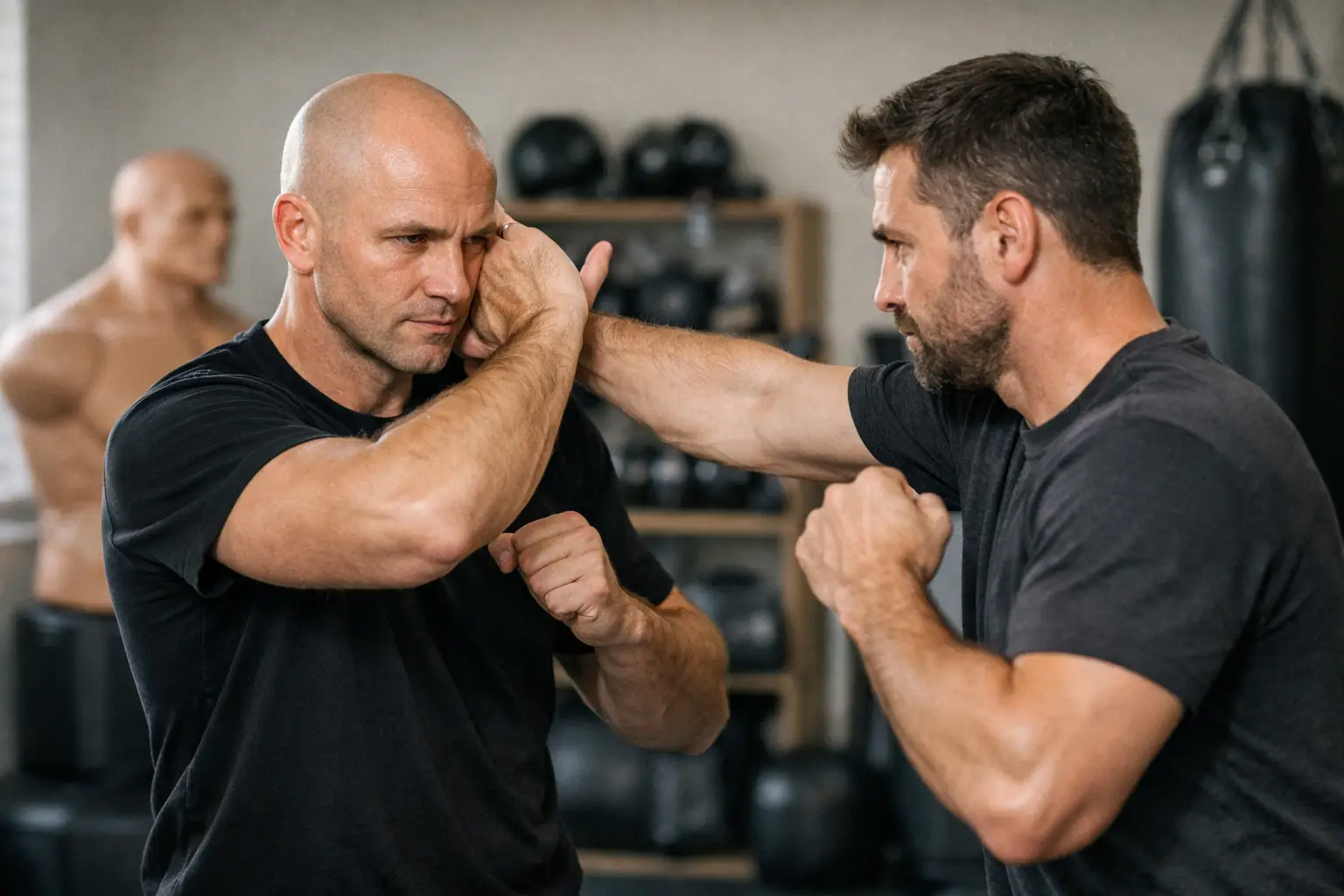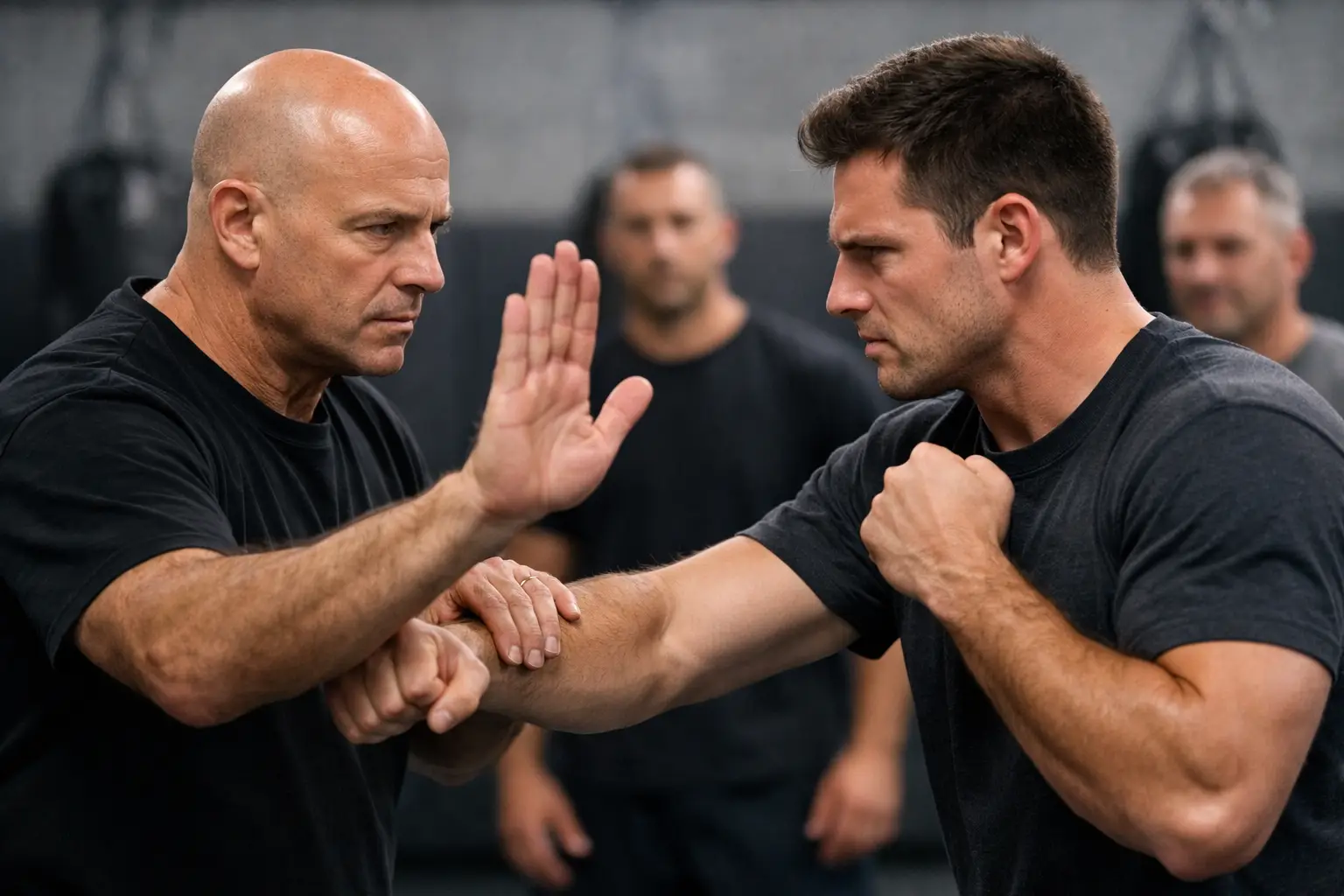
A wrist grab can feel controlling because it is personal, sudden, and close. But learning how to escape wrist grabs is not about winning a grip-strength contest. It is about recognizing the opening in the attacker’s hold, moving your body with purpose, creating distance, and leaving before the situation becomes more dangerous.
Krav Maga treats a wrist grab as a potential beginning, not an isolated event. The person holding your wrist may be trying to stop you from leaving, pull you somewhere else, intimidate you, or set up a second attack. Your response must be simple enough to work under stress and decisive enough to give you an exit.
The Principle Behind How to Escape Wrist Grabs
Every grip has a weak point. When someone closes their hand around your wrist, their fingers create a circle, but the space around their thumb is usually the least secure part of that circle. Rather than pulling straight backward against all of their fingers, direct your escape toward that opening.
This is not a delicate wrist twist. Your larger body movement matters more than arm strength. Keep your elbow close to your body when possible, turn your wrist so the narrow edge of your hand aligns toward the attacker’s thumb, and move your whole body away as you pull free. A step back or angle step can add force while taking you out of the line of a follow-up attack.
The goal is not to stay connected and prove that your technique worked. The goal is to break contact, establish space, and get to safety.
First, Protect Your Position
Before you attempt any release, avoid the common mistake of leaning toward the person holding you. Leaning forward compromises balance and can make it easier for them to pull, shove, or strike you.
Plant your feet in a stable stance, with one foot slightly behind the other if space allows. Keep your knees soft, your posture upright, and your non-grabbed hand available between you and the attacker. That free hand can protect your head, check their shoulder, or create a barrier as you move away.
Use a clear verbal command if it is safe to do so: “Let go!” A loud, direct command can draw attention, establish a boundary, and sometimes disrupt the attacker’s plan. Do not wait for permission to leave. If you can safely disengage, move.
The basic release movement
For a single-hand wrist grab, turn the grabbed hand so the thumb-side opening is in the direction you want to escape. At the same time, pull your arm sharply toward that opening while stepping back or at an angle. Keep the motion compact. Big, circular movements are slower and can expose your face or shoulder.
Imagine that you are pulling your wrist out of the smallest gap in the grip, not yanking it through the strongest part of the attacker’s hand. Your hips and step should support the movement. This is why a smaller person can often release from a stronger person when timing and direction are correct.
As soon as your hand is free, bring it back into a protective position. Create distance immediately. If the attacker advances, use your voice, move toward people or lighted areas, and seek help.
When the Grab Is Stronger or Uses Two Hands
A two-handed grip on one wrist is more controlling. The attacker may try to pull you forward, drag you, or keep you from reaching a phone, door, or other person. Do not stand still and attempt to peel off individual fingers. Under pressure, that approach is slow and unreliable.
Instead, stabilize your base and use your free hand to reinforce your grabbed hand if necessary. Join your hands briefly, orient the grabbed wrist toward the thumb-side weakness of one of the attacker’s hands, and use a sharp body-driven pull as you step away. The free hand adds structure, but your footwork and timing remain the engine of the escape.
If you are being pulled, do not automatically pull in the opposite direction. A sudden change of angle can disrupt the attacker’s balance and reduce the power of their grip. Step to the side, turn your body, and release toward the opening. Then move away rather than remaining close enough to be grabbed again.
A grab with two hands may also be a serious warning sign. If someone is trying to force you into a vehicle, room, alley, or isolated area, the priority is immediate escape, noise, and attention. Use every lawful opportunity to break contact and get toward safety.
Avoid These Common Mistakes
Many wrist-grab escapes fail because people train them as arm movements instead of full-body actions. The first mistake is trying to outmuscle the grab. If the attacker is larger, angry, or using both hands, pure pulling strength is unlikely to be enough.
The second mistake is focusing only on the wrist. Your eyes should remain on the person, their shoulders, their free hand, and the space around you. A wrist grab can distract you from a punch, a push, a weapon, or a second person approaching.
The third mistake is stopping after the release. Breaking the grip is not the finish line. Reset your stance, protect your head, create distance, and leave. In real self-defense, distance is often your best protection.
Finally, do not rely on a complicated sequence that demands perfect hand placement. Fine motor skills degrade under adrenaline. A practical response should use gross movement: a stable stance, a direct turn, a forceful pull through the weak point, and immediate movement away.
Practice the Right Way
You can begin by practicing the movement pattern slowly, even without a partner. Rehearse your stance, your verbal command, the wrist orientation, the pull, and the step away. The goal is to make the mechanics familiar before adding speed.
Partner practice is valuable, but it must be controlled. Start with a cooperative grip so you can understand the direction of the thumb-side opening. Then gradually vary the pressure, angle, and timing. A training partner should release once the escape is correctly performed rather than trying to “win” the drill.
As skill improves, practice realistic variables. Work from a neutral standing position, while walking, with your attention briefly elsewhere, and with verbal pressure. Practice releases from both wrists and from different angles. The technique should remain simple even as the scenario changes.
Avoid training at maximum force without qualified supervision. Wrist grabs can cause falls, shoulder strain, or joint injury when partners pull recklessly. Controlled repetition develops dependable movement far better than chaotic sparring without clear safety rules.
Context Changes the Best Response
There is no single wrist-grab escape that fits every situation. If the person is a confused relative, an intoxicated stranger, or someone creating a disturbance in a public place, verbal boundaries and a controlled release may be enough. If the person is attempting to abduct, assault, or restrain you, your response must be faster, louder, and focused on immediate escape.
Your environment matters too. On stairs, near traffic, in a crowded venue, or around hard surfaces, preserving your balance may be more urgent than performing a textbook release. Sometimes the best move is to brace, use a loud command, and move toward witnesses before attempting to disengage.
For law enforcement, security, and close-protection professionals, policy, legal authority, team position, and duty of care also shape the response. Civilian self-defense has a different objective: break contact, avoid escalation where possible, and get safe.
Build a Response You Can Use Under Stress
Reliable self-defense is built through progression. You learn the underlying principle, repeat it until the body understands it, then test it against increasingly realistic pressure. That is more valuable than collecting dozens of flashy releases you cannot recall when startled.
Krav Maga Online teaches wrist-grab defenses within a structured curriculum designed for real-world decision-making, from beginner foundations through advanced professional applications. The value of guided training is not merely seeing a technique once. It is learning when to use it, how to adapt it, and how to recover your position when the first attempt does not go perfectly.
A wrist grab is often an attempt to take away your freedom of movement. Train to recognize that moment, protect your balance, move through the weak point, and make distance your priority. The most effective escape is the one that gets you home safely.