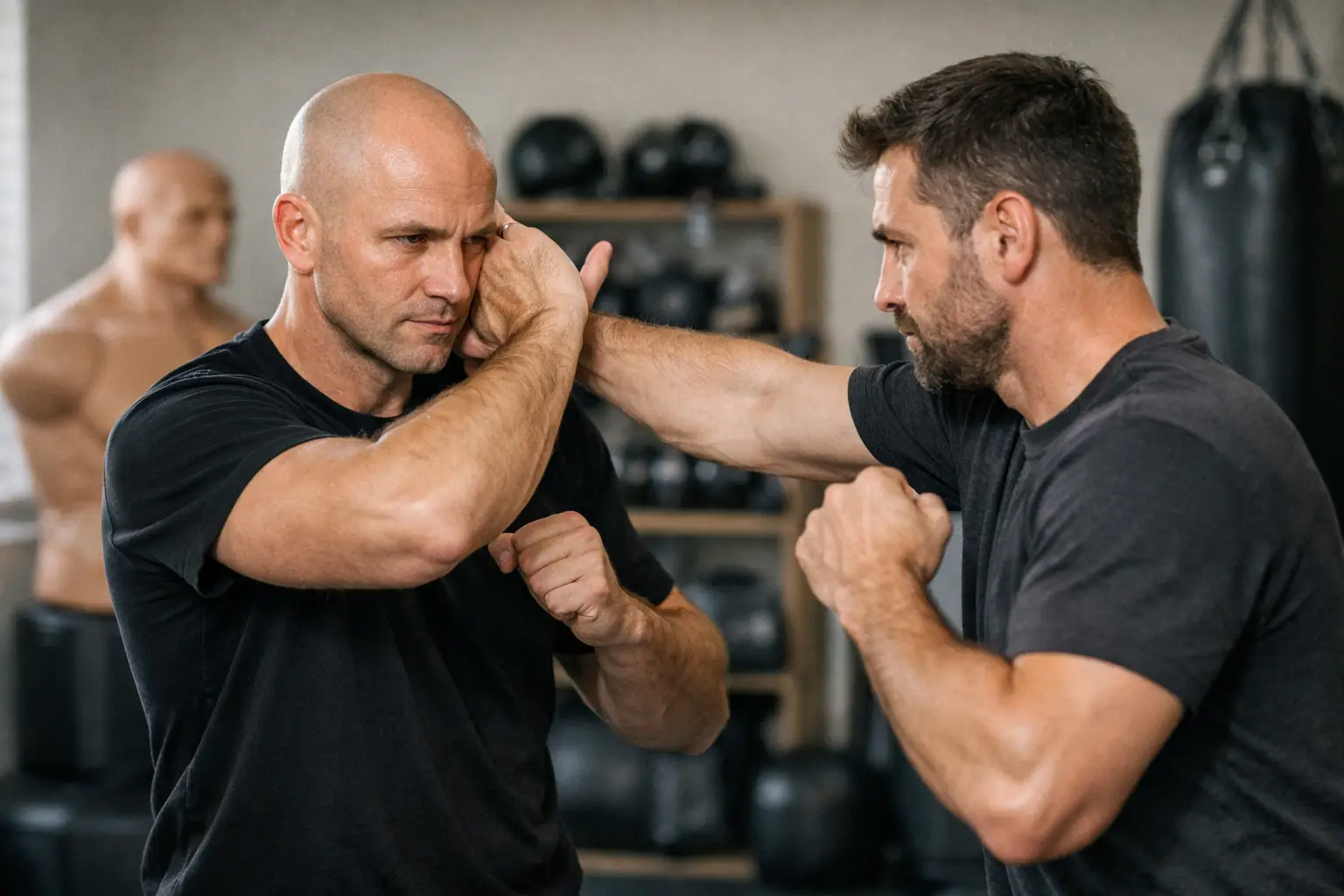
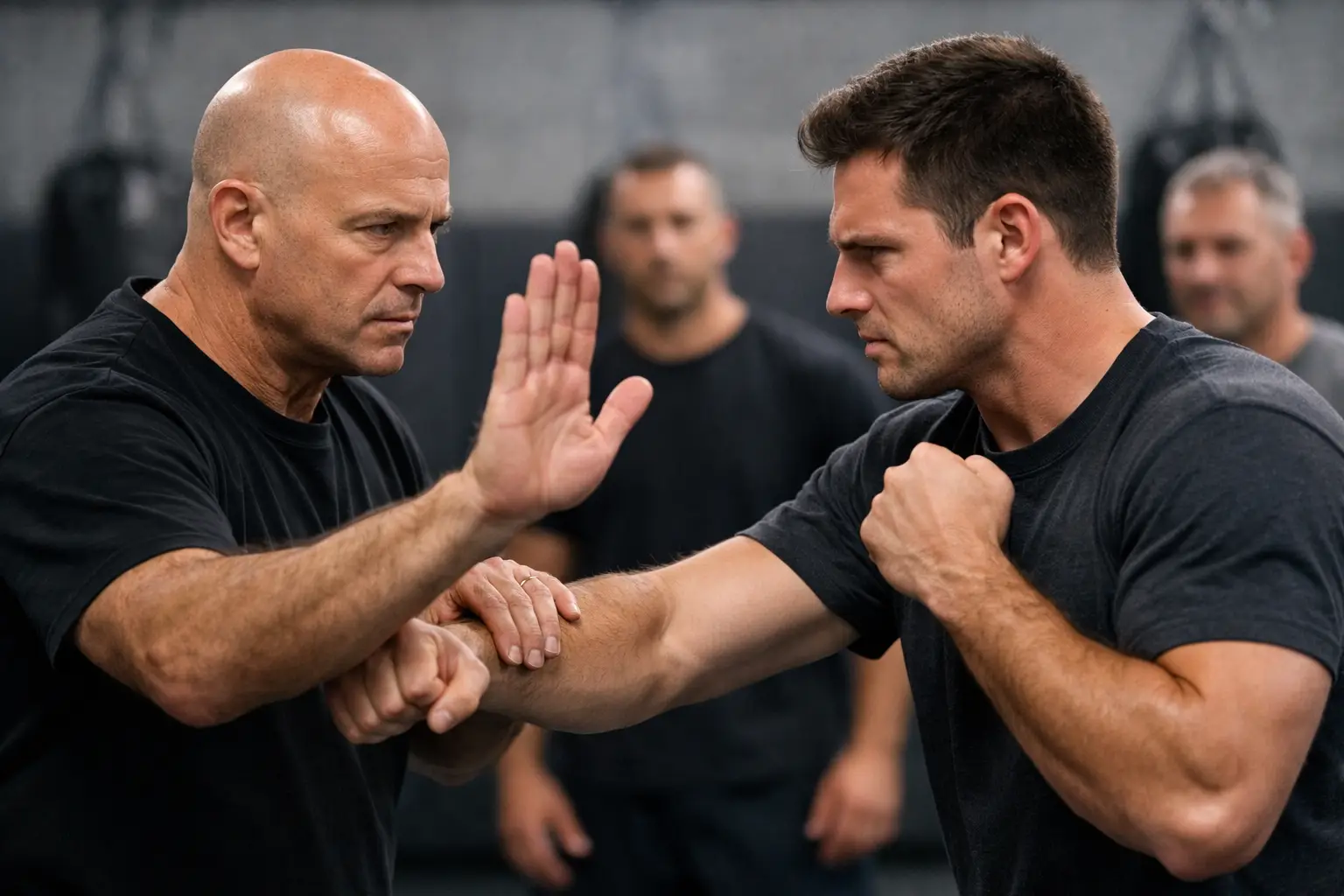
A confrontation rarely begins with a clear warning. It may start with someone crowding your space, challenging your words, blocking your path, or refusing to let a minor disagreement end. To de-escalate conflict safely, your objective is not to win the argument or prove toughness. It is to reduce danger, create space, and leave before a verbal problem becomes a physical one.
That mindset is central to practical self-defense. Real-world safety is not measured by who delivers the last line or lands the final strike. It is measured by whether you recognize risk early, make sound decisions under stress, and get yourself and the people with you to safety.
What De-Escalation Really Means
De-escalation is the deliberate use of communication, positioning, awareness, and restraint to lower the intensity of a conflict. It does not mean being passive. It does not require accepting threats, harassment, or intimidation. It means choosing actions that give the other person fewer reasons and fewer opportunities to become violent.
A calm response can help when the other person is frustrated, embarrassed, intoxicated, or looking for attention. But calm words alone are not a security plan. If someone is making threats, displaying a weapon, following you, trapping you in a confined area, or becoming more aggressive as you try to disengage, the priority shifts immediately: create distance, seek help, and escape if you can.
The hard truth is that you cannot always talk someone down. You can control your own behavior, body position, and decisions. You cannot control another person’s level of judgment, substance use, emotional state, or intent.
Read the Situation Before You Speak
Your first advantage is recognition. Many people focus so closely on the words being said that they miss the physical cues that reveal a changing threat. Notice whether the person is closing distance, staring at your hands or waist, clenching fists, blading their body, pacing, looking around for friends, or repeatedly checking behind them. These behaviors do not guarantee an attack, but they should change how you position yourself.
Watch the environment as well. A loud bar, parking garage, elevator, crowded transit platform, or isolated street each creates different problems. In a public place, moving toward staff, security, a well-lit entrance, or a group of bystanders may improve your options. In a confined space, avoid allowing yourself to be pinned against a wall, vehicle, counter, or doorway.
Your distance should match the level of concern. If the person is upset but not advancing, stay outside arm’s reach and keep an open path to leave. If they move closer, you move as well. Do not let politeness turn into poor positioning.
Use Words That Lower the Temperature
The most effective language is short, calm, and practical. Under stress, long explanations often sound defensive or argumentative. A person who feels challenged may hear your detailed reasoning as an invitation to keep debating.
Use a steady voice and simple statements: “I don’t want a problem.” “You’re right, I’m leaving.” “I hear you.” “Let’s give each other space.” “I can’t help with that.” These phrases are not admissions of weakness. They are tools for ending contact without adding fuel.
Avoid insults, sarcasm, threats, public humiliation, and attempts to diagnose the other person. Telling an aggressive stranger to “calm down” can work in some situations, but it can also sound dismissive. A better approach is to describe your own action: “I’m going to step back,” or “I’m leaving now.”
Apologizing can be useful when it costs you nothing and gives the person a face-saving exit. If you bumped into someone, misunderstood a line, or made an accidental mistake, a direct apology may end the issue quickly. But do not negotiate away your safety. You do not need to hand over your phone, enter a vehicle, go somewhere private, or follow someone outside to prove that you are reasonable.
Position Your Body for Safety
Words matter, but body language often speaks first. Keep your hands visible around chest level in a nonthreatening, conversational position. This can signal that you do not want to fight while also placing your hands in a useful position if you must protect yourself.
Stand at an angle rather than squarely facing the person. This reduces the target area in front of you, helps your balance, and makes it easier to move. Keep your feet under you, avoid crossing your legs, and maintain enough room to step away. Do not point, poke, shove, or place a hand on the other person unless there is an immediate need to protect yourself.
Your face should match your intent. A hard stare, smirk, clenched jaw, or raised chin can be read as a challenge. Keep your expression composed, scan your surroundings, and look for exits without making sudden, panicked movements.
If you are with family, friends, or coworkers, communicate simply. Tell them to move toward the exit, call for help, or stay behind you as you create distance. Do not let a group discussion form around the aggressor. More voices often create more confusion.
When to Leave, Call for Help, or Defend Yourself
The safest de-escalation technique is leaving early. If you have a clear exit, use it. Do not remain because you want closure, because your pride is involved, or because you believe walking away looks weak. A stranger’s opinion is not worth a hospital visit, an arrest, or a lifelong injury.
Call 911 or seek immediate assistance when there are credible threats, a weapon, physical assault, stalking, attempted abduction, serious impairment, or an inability to get away safely. Be specific when asking others for help. Instead of yelling “Someone help,” point to a person and say, “You in the blue shirt, call 911.” Direct instructions are more likely to produce action.
Physical self-defense becomes relevant when avoidance and escape are no longer available and you reasonably need to protect yourself or another person from immediate harm. The goal is not punishment. Use only the force necessary to break contact, create an escape opportunity, and get to safety. Once you can leave, leave.
This is where structured training matters. Pressure changes coordination, awareness, and decision-making. Krav Maga Online teaches a progression built around practical movement, defensive posture, escape-focused responses, and the judgment to recognize when a situation has crossed from verbal conflict into immediate danger. Training should build confidence without creating false confidence.
Common Mistakes That Escalate a Conflict
People often make a bad situation worse without realizing it. The following mistakes are especially costly because they give an aggressive person more attention, more emotional energy, or better access to you:
- Trying to win the audience instead of ending the interaction.
- Moving closer to be heard or understood.
- Reaching into pockets, bags, or a vehicle without explaining what you are doing.
- Allowing yourself to be led to a quieter, more isolated location.
- Assuming an apology or calm tone guarantees the person is no longer dangerous.
- Staying after the conflict appears over, rather than leaving the area.
There is also a legal and personal aftermath to consider. A physical altercation can involve witnesses with incomplete views, security cameras, police reports, medical treatment, and consequences that continue long after the moment ends. Your conduct before, during, and after the event matters. If you are safe, report serious threats or assaults, preserve relevant details, and avoid returning to confront the person again.
Practice the Skill Before You Need It
You do not need to wait for a crisis to improve your de-escalation ability. Rehearse simple verbal exits. Practice standing with your hands visible, moving backward without crossing your feet, and identifying exits when you enter unfamiliar places. Notice where you park, where staff are located, and where crowded spaces may become bottlenecks.
Training with realistic scenarios helps connect these habits to stress. The aim is not to become fearful or suspicious of everyone around you. It is to become harder to surprise, easier to protect, and more capable of making a clean decision when tension rises.
The strongest response to conflict is often quiet and unremarkable: you recognize the danger, refuse the ego trap, create space, and go home safely. That is not backing down. That is disciplined self-protection.