A patrol officer rarely gets to choose the time, distance, or conditions of a confrontation. A routine contact can become a hands-on struggle in a parking lot, hallway, stairwell, or crowded home with almost no warning. That is why Krav Maga for law enforcement training must be more than a collection of techniques. It must build fast decision-making, reliable body mechanics, controlled aggression, and the ability to return to communication and command presence as soon as possible.
The objective is not to win a fight for its own sake. The objective is to recognize danger early, protect yourself and others, gain control when necessary, and apply force that is justified, proportionate, and consistent with agency policy. Done correctly, Krav Maga supports that mission with direct, reality-based training that does not depend on athleticism, ideal conditions, or a perfect opponent.
Why Conventional Training Can Leave Gaps
Firearms qualification, defensive tactics blocks, arrest procedures, and scenario work all matter. Yet many officers receive limited repetition of the moments that happen between verbal commands and control: a sudden grab, a driving tackle, an attempted weapon takeaway, a strike thrown at conversational range, or a suspect who refuses to disengage.
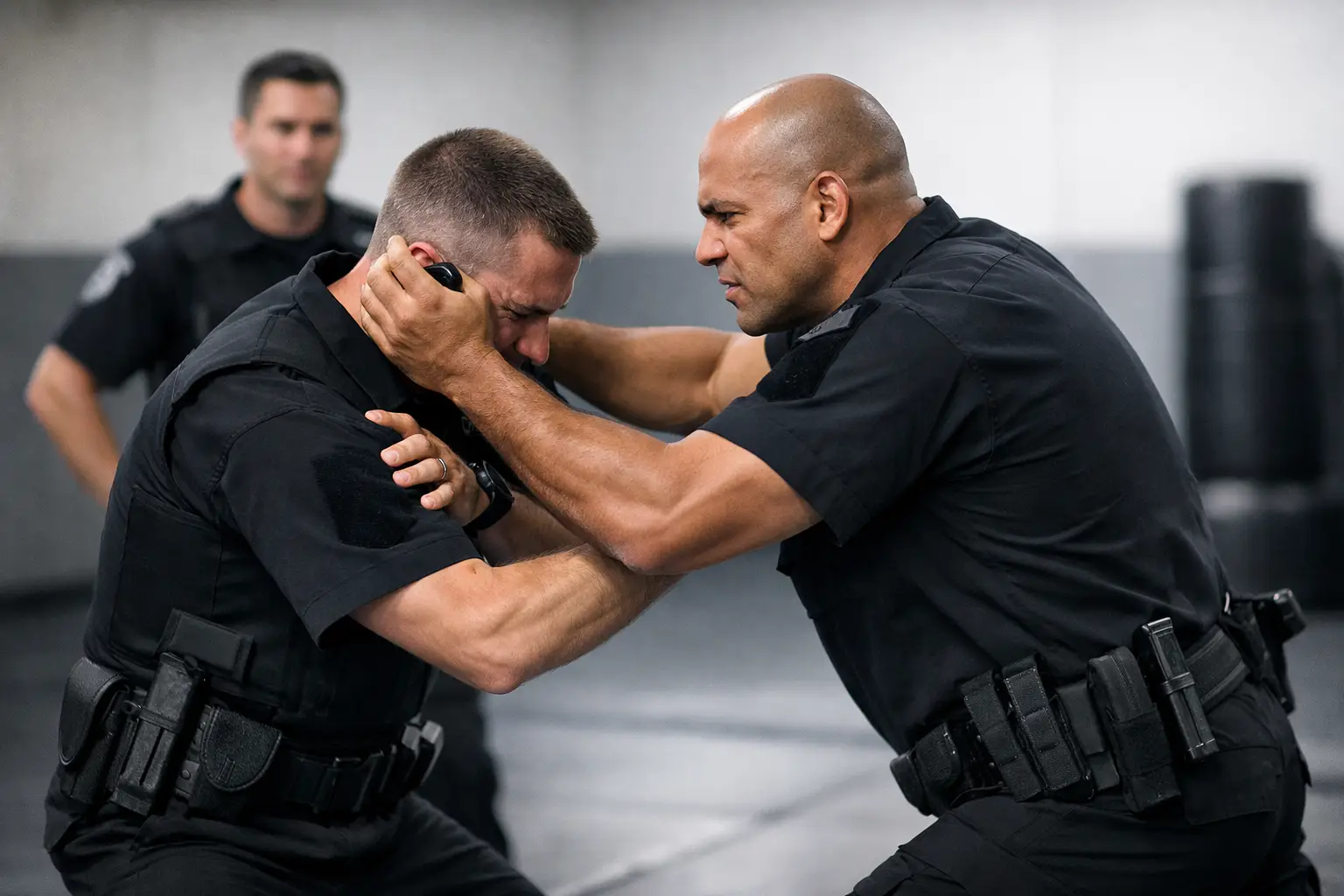
Those moments are chaotic. Fine motor skills deteriorate under stress. Equipment changes movement. Duty belts catch, body armor restricts rotation, and a radio or holster can become a point of vulnerability. A system designed for law enforcement must acknowledge those realities instead of relying on complicated sequences that work only in a controlled training room.
Krav Maga emphasizes gross-motor responses, balance disruption, protective movement, rapid disengagement, and decisive counteraction. It gives officers practical answers for close-range violence while reinforcing a critical professional standard: stop when the threat stops, create space when possible, and transition to control, communication, or medical aid as the situation requires.
What Krav Maga for Law Enforcement Training Should Develop
Effective police-focused Krav Maga is not civilian self-defense simply taught at a faster pace. It should be adapted to the officer’s legal responsibilities, equipment, mission, and team environment.
Awareness Before Contact
The first skill is not a strike or a takedown. It is recognition. Officers need to read pre-assault indicators, manage reactionary distance, position themselves near exits and cover, and avoid standing squarely in front of a subject whose behavior is escalating.
Training should reinforce verbal de-escalation and tactical positioning together. A strong stance, hands in a non-threatening but ready position, and awareness of the subject’s hands can prevent a problem from becoming a physical encounter. Krav Maga sharpens this transition from interview posture to protective action without requiring a long setup.
Defending the Most Common Sudden Attacks
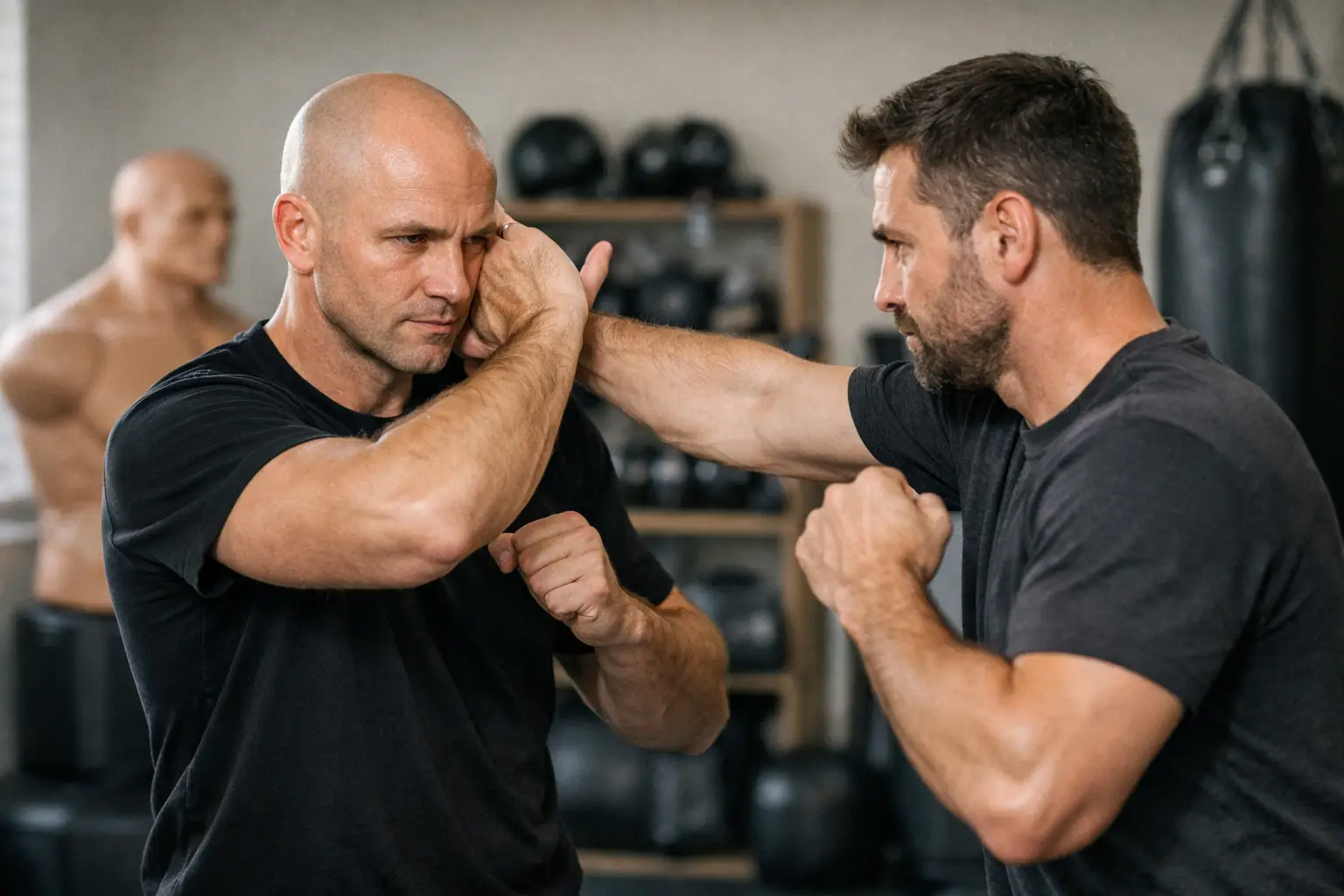
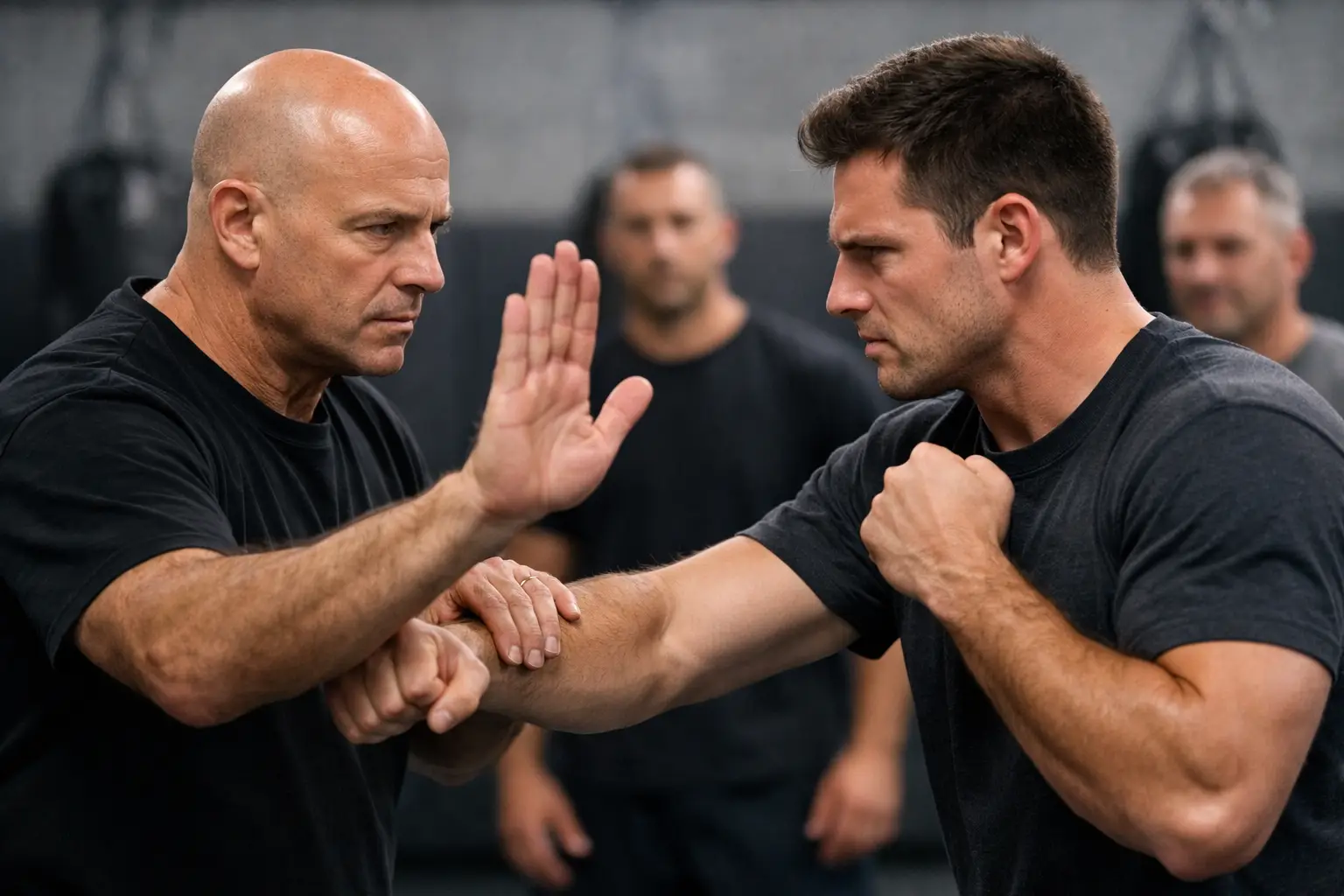
The most valuable responses are often the simplest: escapes from grabs and chokes, defenses against common punches, protection from tackles, movement against pushes, and recovery from compromised positions. These are not glamorous skills, but they address the close-range attacks officers may encounter before they can access tools or call for support.
The standard should be repeatability. Can an officer perform the response while fatigued, wearing armor, managing a radio, and reacting to an unscripted training partner? If the answer is no, the technique needs refinement. Under pressure, a simple movement delivered with commitment is more dependable than a detailed sequence with multiple points of failure.
Ground Survival and Recovery
Going to the ground is not always avoidable. Slippery surfaces, uneven terrain, tackles, and confined spaces can put an officer at a disadvantage quickly. Ground survival training should focus on protecting the head, managing distance, escaping dangerous positions, preventing weapon access, and standing up safely.
This is where the purpose of Krav Maga differs from a sport grappling match. The goal is generally not to remain on the ground and outscore an opponent. It is to avoid injury, regain mobility, create enough separation to assess the threat, and move toward a safer position. Agencies may pair this work with dedicated arrest-control and grappling instruction for a more complete capability.
Weapon Retention and Threat Recognition
An officer’s duty weapon, less-lethal tools, restraints, and communication equipment alter every physical encounter. Training must include retention concepts, holster awareness, protection of the weapon side, and responses to attempts to grab or pin equipment.
There is a necessary trade-off here. Weapon-related drills require careful supervision, clear safety protocols, inert training equipment, and a deep understanding of agency policy. They should never create false confidence. The right program teaches officers to recognize the danger early, protect access points, move off line, and seek assistance or disengagement when that is the safest available option.
Pressure Testing Turns Movements Into Skills
Technique instruction alone does not create operational readiness. An officer may understand a defense intellectually and still freeze when a partner adds speed, noise, resistance, verbal aggression, or uncertainty.
Pressure testing closes that gap gradually. Training can begin with precise mechanics, then progress to movement, protective gear, environmental variables, role-play, and decision-making drills. The escalation must be controlled. The purpose is to build performance under stress, not to injure trainees or reward reckless behavior.
A quality session asks realistic questions. Did the officer identify the threat? Did they protect their head and equipment? Did they use appropriate verbal commands? Could they disengage? Did they continue applying force after control was regained? These questions matter as much as whether a technique looked clean.
The Role of Judgment, Policy, and Documentation
Krav Maga can improve physical capability, but no martial art replaces legal standards, departmental policy, or sound judgment. Force decisions are shaped by the totality of circumstances, the immediacy of the threat, the officer’s perception, local law, and agency rules. Training must stay connected to those responsibilities.
For that reason, the strongest law enforcement programs integrate physical skills with communication, scenario judgment, team coordination, medical priorities, and post-incident awareness. Officers should practice giving commands while moving, recognizing when a subject is no longer an active threat, calling for backup, and checking for injuries once the scene is safe.
This integration protects the public and the officer. Physical competence without restraint can create unnecessary risk. Restraint without the ability to act decisively can leave officers and bystanders exposed. Professional training develops both.
Building a Training Plan That Holds Up
A single defensive tactics day is useful, but it does not create retention. Skills decay when they are not revisited. A better model combines structured progression with short, consistent practice sessions and periodic hands-on validation.
Officers can use video-based instruction to review movement principles, terminology, common attacks, and training sequences on a flexible schedule. That accessibility is especially valuable for shift workers, rural departments, security professionals, and those without a nearby specialized academy. But online learning has a clear limit: physical technique, resistance, safety, and scenario performance require qualified in-person practice.
Krav Maga Online provides structured belt progression and professional-level curriculum access that can help motivated learners build a consistent knowledge base between live sessions. Used responsibly, digital training supports repetition and preparation. It should complement, not replace, agency-approved instruction, certified supervision, and training with capable partners.
A Practical Weekly Approach
A sustainable routine does not need to consume every off-duty hour. One session can focus on movement, stance, and defenses against common grabs. Another can cover striking mechanics, pad work, and recovery after contact. A third can be partner-based, emphasizing controlled resistance, verbal commands, equipment awareness, and escape-to-control decisions.
As competence grows, add scenario variables rather than endlessly adding techniques. Train in low light where appropriate, use verbal stress, practice from seated positions, include obstacles, and require a clear transition after the physical exchange. The officer should finish the drill by creating distance, communicating, scanning, and following the relevant procedure.
Train for the Encounter You Hope Never Happens
The value of Krav Maga is not measured by how many techniques an officer can recite. It is measured by whether they can stay composed when distance collapses, protect themselves without losing judgment, and regain control when the situation turns physical. Build the skill before the call comes, test it honestly, and keep training with the discipline the job demands.