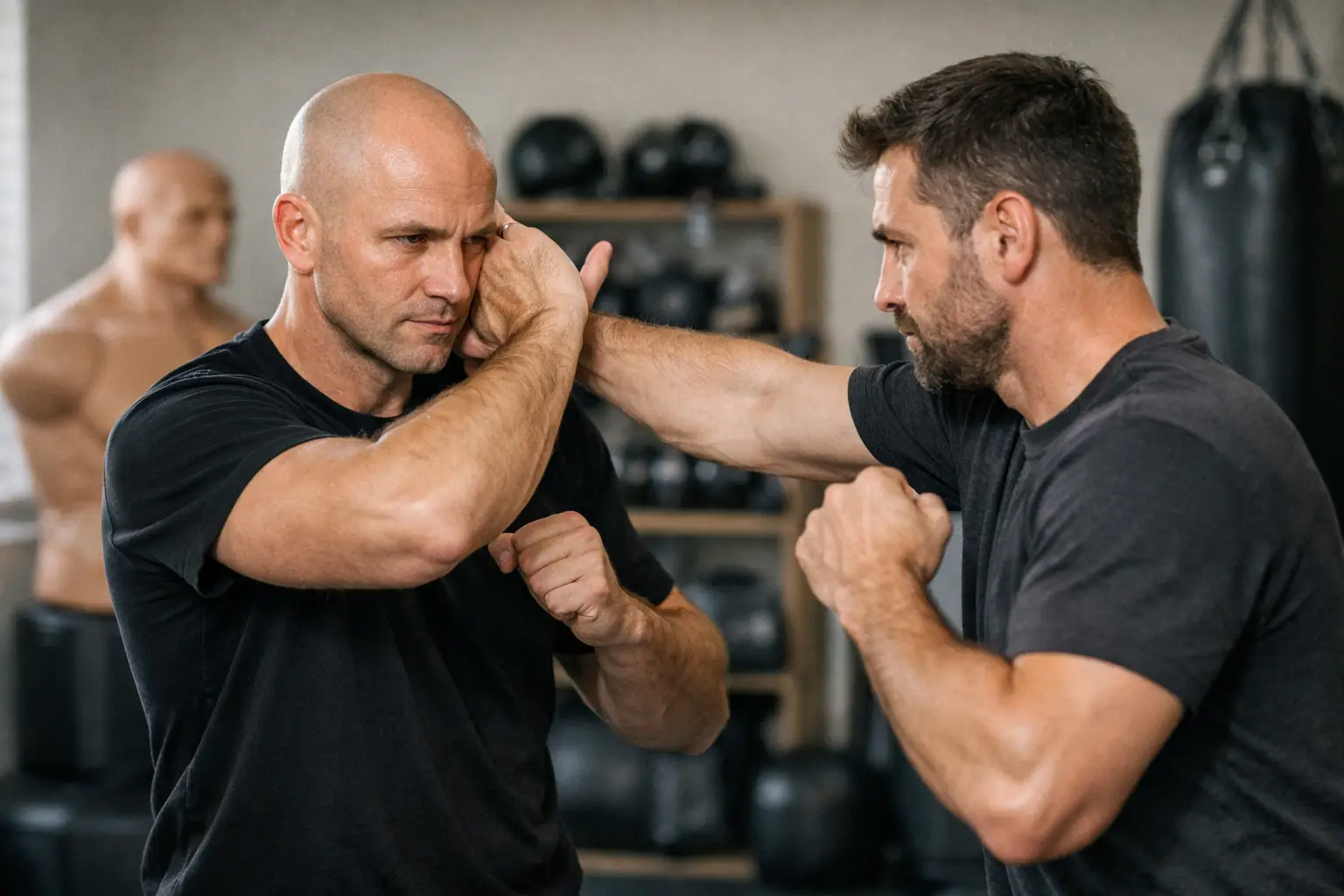
A threat does not need to throw a punch to put you in danger. If someone is close enough to grab, shove, trap you against a wall, or produce a weapon, the encounter may already be moving too fast. Distance management drills teach you to recognize that moment early, move with purpose, and create the space required to leave or defend yourself.
For Krav Maga students, distance is not a sport-fighting detail. It is a survival variable. The correct range determines whether you can run, use your voice, strike, defend against a grab, or access an appropriate tool. Training it consistently makes your reactions less dependent on luck.
What Distance Management Really Means
Distance management is the ability to identify and control the space between yourself and another person. It includes how far away you stand, the angle you choose, how you move when someone closes in, and whether your hands and body position support an immediate response.
There is no single “safe distance.” A person’s reach, speed, emotional state, environment, and potential weapon all change the calculation. A crowded elevator gives you few options. A parking lot gives you more room but may offer poor visibility or obstacles underfoot. Your goal is not to maintain a perfect fighting stance everywhere you go. Your goal is to avoid being caught flat-footed at the range where an aggressor can act before you recognize the threat.
A useful self-defense model divides distance into three practical zones. Outside range is where a person cannot touch you without taking a clear step. Contact range is where they can grab, push, or strike with little warning. Close range is where bodies may collide and the situation can become a clinch, a restraint, or a ground survival problem.
The strongest choice is often to remain outside range while maintaining awareness and an exit route. If an aggressor enters contact range, your response must be immediate and decisive: set boundaries, move, create space, and leave when a path opens.
Why Distance Management Drills Matter Under Stress
Many people understand personal space in calm situations but lose it under pressure. They freeze when a stranger keeps advancing. They back straight into a wall, a parked car, or a group of people. Or they focus on the aggressor’s hands and forget to scan for an exit.
Distance management drills turn awareness into movement. They build the habit of moving diagonally rather than retreating in a straight line, keeping the hands in a natural protective position, and using verbal commands while the feet create space. This is especially valuable for people who train online or alone, because the fundamentals can be developed before adding pressure with a partner.
These drills are not about looking impressive. They are about giving yourself more time to perceive, decide, and act. Even a half-step of extra space can mean the difference between avoiding contact and having to fight through it.
Build Your Protective Position First
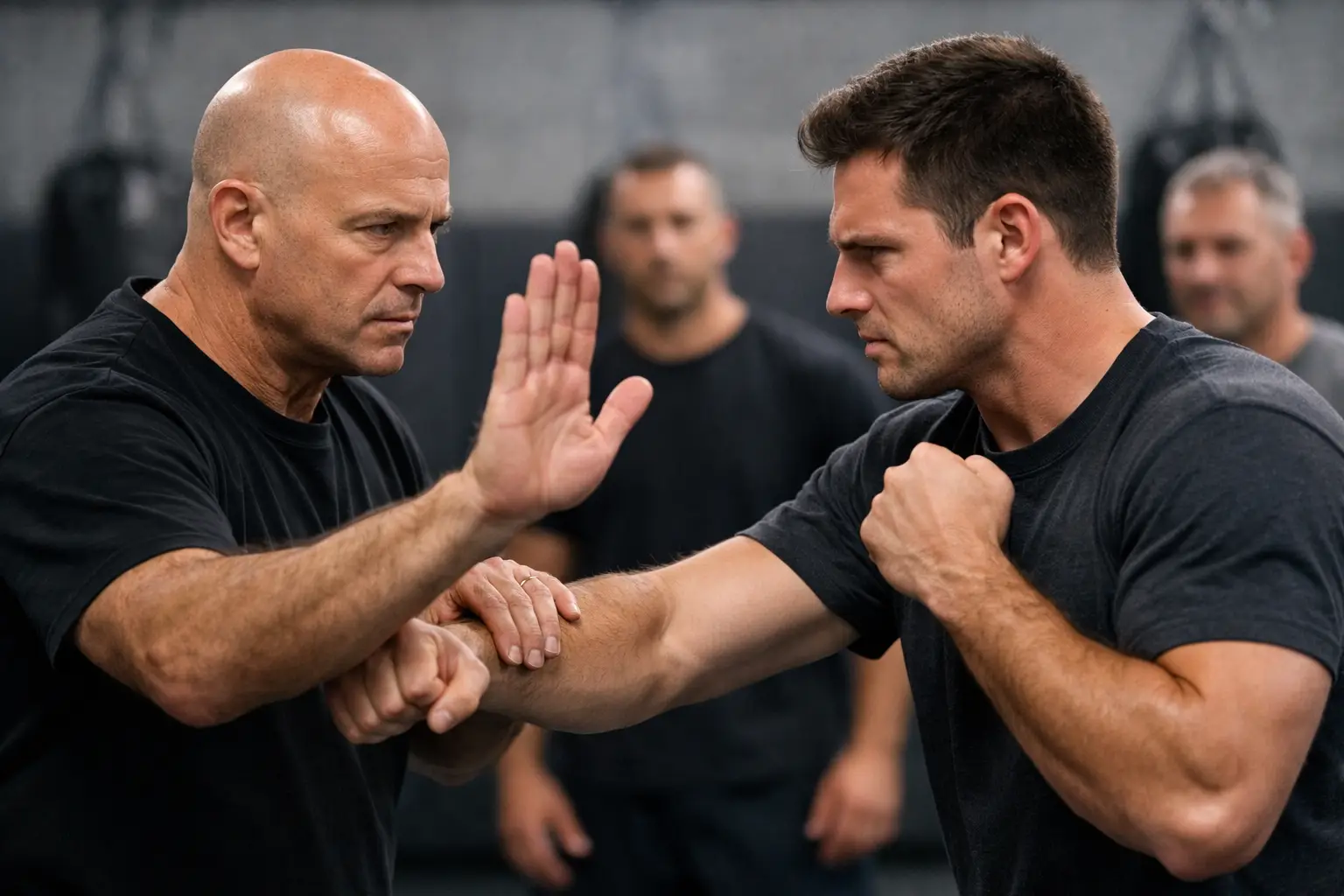
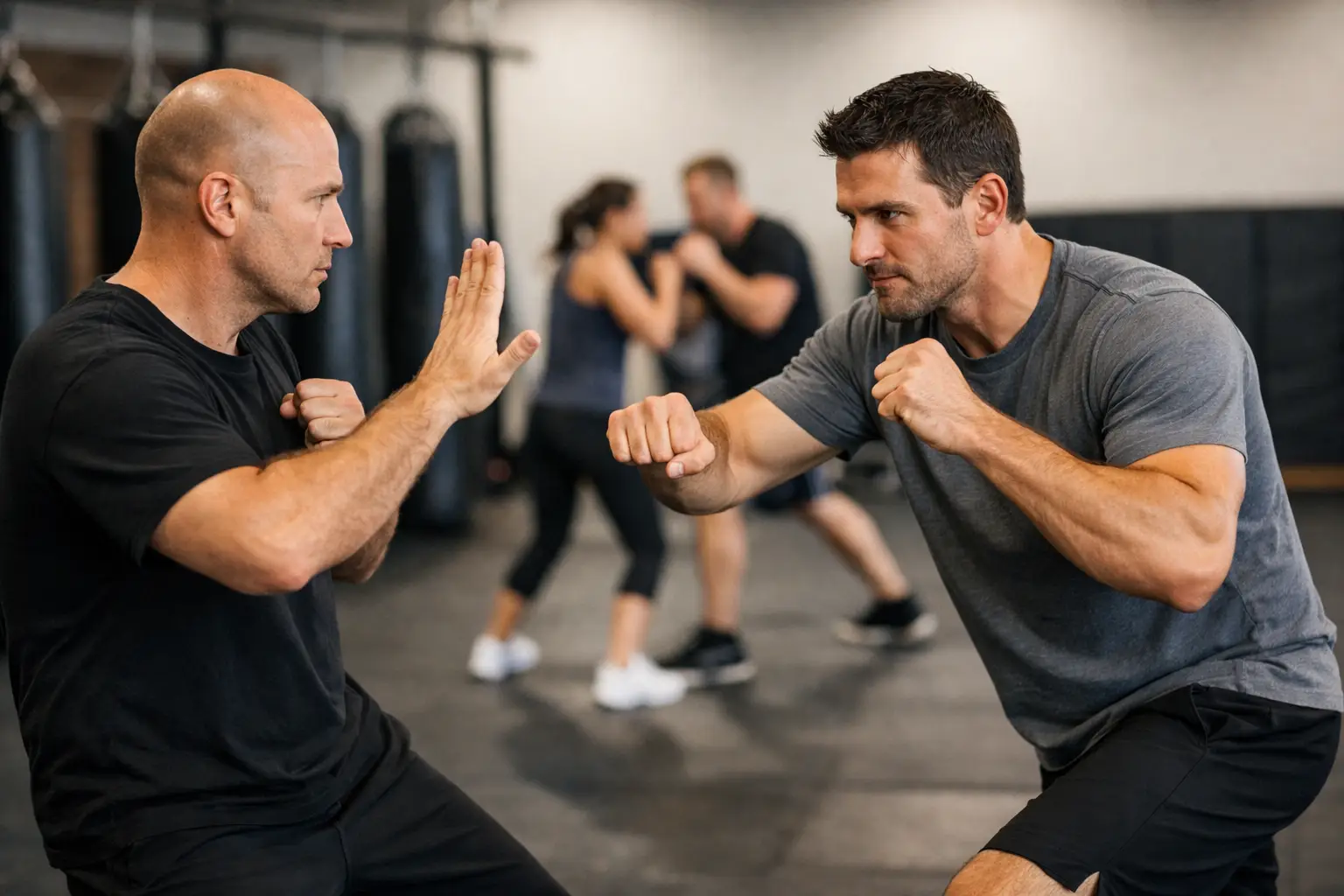
Before practicing movement, establish a position you can use without drawing unnecessary attention. Stand with your feet about shoulder width apart, one foot slightly behind the other, knees relaxed, and weight balanced enough to move in any direction. Keep your hands up around chest level with open palms when appropriate. This can look like a non-threatening boundary gesture while protecting your head and preparing you to frame, redirect, or strike if necessary.
Avoid standing square with locked knees and hands buried in pockets. That posture delays your response. At the same time, do not adopt an exaggerated combat stance during every uncomfortable conversation. A visible fighting posture can escalate a situation. Your posture should fit the context while preserving mobility.
Drill 1: The Boundary Step
Mark a line on the floor with tape or use a seam between tiles. Begin several steps away from the line in your protective position. Walk toward it naturally, then stop at the line, bring your hands into a calm fence position, and say a clear command such as, “Stop there” or “Back up.”
Next, take one diagonal step away from the line while maintaining your balance and keeping your eyes forward. Reset and repeat on both sides. The purpose is to connect voice, hand position, and footwork. You are training your body not to freeze when someone crosses the distance you consider acceptable.
Practice slowly at first. Speed is useful only when your stance stays stable and your verbal command remains clear.
Drill 2: The Exit Angle Drill
Place two markers on the floor about six to eight feet apart. Stand between them, facing an imagined aggressor. On a timer, move to either marker using a diagonal step, then continue two or three steps toward a designated exit point.
Do not simply shuffle sideways. Turn your body enough to move efficiently, but keep the imagined threat in your field of view until you have created meaningful space. Add a verbal command as you move: “Stay back.” Then scan left and right before resetting.
This drill addresses a common mistake: creating a small amount of distance, then stopping. In real self-defense, the first movement should lead somewhere useful. A door, a well-lit area, other people, or an open route away from danger are all better destinations than a random step backward.
Partner Drills That Develop Timing
A trustworthy training partner can add realism, but control is non-negotiable. Start with clear rules: no surprise attacks, no hard contact, no weapons, and an immediate stop when either person calls out. Protective equipment becomes appropriate as drills progress, particularly when adding strikes or aggressive forward pressure.
Drill 3: The Advancing Partner Drill
One partner starts several steps away and walks forward at a steady pace. The defender uses posture, open hands, verbal boundaries, and diagonal movement to maintain outside range. The advancing partner stops immediately when told to stop.
After several repetitions, vary the pace. The partner may hesitate, walk faster, or angle toward one side. The defender’s job is not to predict an attack. It is to notice the loss of space early and move before they are trapped.
A valuable variation is to place the defender near a wall, chair, or doorway. Environmental pressure reveals whether your movement works outside an open training area. If the path is blocked, the defender should angle toward the available exit, not retreat blindly into the obstacle.
Drill 4: Touch-and-Exit Drill
At a controlled contact range, the partner reaches slowly to touch the defender’s shoulder or upper arm. The defender uses a simple frame or redirection appropriate to their training, steps off-line, creates distance, and moves toward the exit point.
The key is the sequence: defend the immediate contact, make space, then disengage. Do not remain in front of the partner to trade techniques. Self-defense favors escape when escape is available.
Keep this drill light until both people can move safely. The purpose is timing and positioning, not winning a sparring exchange.
Add Awareness, Not Just Footwork
Footwork alone is incomplete. A person can move well in a drill and still miss a second threat, a curb, a vehicle, or the fact that their escape route has closed. Once the basic movements feel natural, add decision-making.
Have a partner call out a direction while you move. Train in different shoes and on different safe surfaces. Practice identifying exits in familiar places such as your home, office, or parking area. If you train with a partner, ask them to hold up a number of fingers after you move, then call out the number. This encourages you to keep your head up rather than staring at the ground.
Use caution with scenario training. Intensity is helpful only when it supports learning. If the drill becomes chaotic before your fundamentals are reliable, you may rehearse panic instead of useful movement.
Common Errors That Collapse Your Distance
The first error is backpedaling in a straight line. Straight retreat gives an aggressor a simple path to follow and increases the chance of tripping. Angle away whenever the environment permits.
The second is crossing your feet while moving quickly. Crossing may feel fast, but it can remove your base at the exact moment you need to stop, strike, or change direction. Short, balanced steps are more dependable.
The third is treating verbal commands as optional. Clear, assertive language can establish boundaries, draw attention, and help witnesses understand who is attempting to disengage. Your voice should support your movement, not replace it.
Finally, do not confuse distance management with avoidance of all conflict. If you cannot move because you are grabbed, cornered, or protecting another person, you may need close-range defensive skills. That is why structured Krav Maga training develops distance, releases, striking, and escape as connected skills rather than isolated techniques.
Train for the Distance You Need
Practice these drills for short sessions two or three times per week. Start with clean movement, then add verbal commands, environmental obstacles, and controlled partner pressure. Record yourself occasionally. You will quickly see whether your hands drop, your feet cross, or your exit path disappears when you accelerate.
Krav Maga Online provides a structured progression for students who want to build these skills from fundamental movement through advanced self-defense applications. The standard is not flashy footwork. It is the ability to recognize danger, manage range, and move toward safety with control.
The next time you enter a room, do not only notice who is there. Notice where you would go if someone moved too close.