A self-defense skill is only useful if you can access it when your heart rate rises, your space disappears, and there is no time to think through a complicated sequence. That is why essential defense techniques must be direct, repeatable, and built around one priority: creating the opportunity to get safe.
Krav Maga is not about winning a contest or proving toughness. It is a reality-based system that teaches you to recognize danger early, protect yourself under pressure, disrupt an assault when necessary, and leave the area. Beginners can start developing these habits immediately, but they must train them with structure, control, and consistent repetition.
Start With Awareness, Positioning, and Distance
The strongest defense often happens before physical contact. Awareness is not paranoia. It is the disciplined habit of noticing your environment, identifying exits, and refusing to let a stranger close distance without a reason.
When you enter a parking garage, elevator, stairwell, or unfamiliar building, avoid becoming absorbed in your phone. Keep your head up. Notice who is nearby, where you can move, and what may restrict your path. If someone makes you uncomfortable, trust that signal early. Cross the street, move toward people, enter a business, or call for assistance before the situation becomes physical.
Distance gives you time. An attacker who is outside reach has fewer immediate options than one who has already crowded your body, grabbed your clothing, or backed you against a wall. If someone approaches aggressively, move off the direct line instead of retreating in a straight line. Angle your body slightly, keep your hands visible around chest level, and maintain enough space to react.
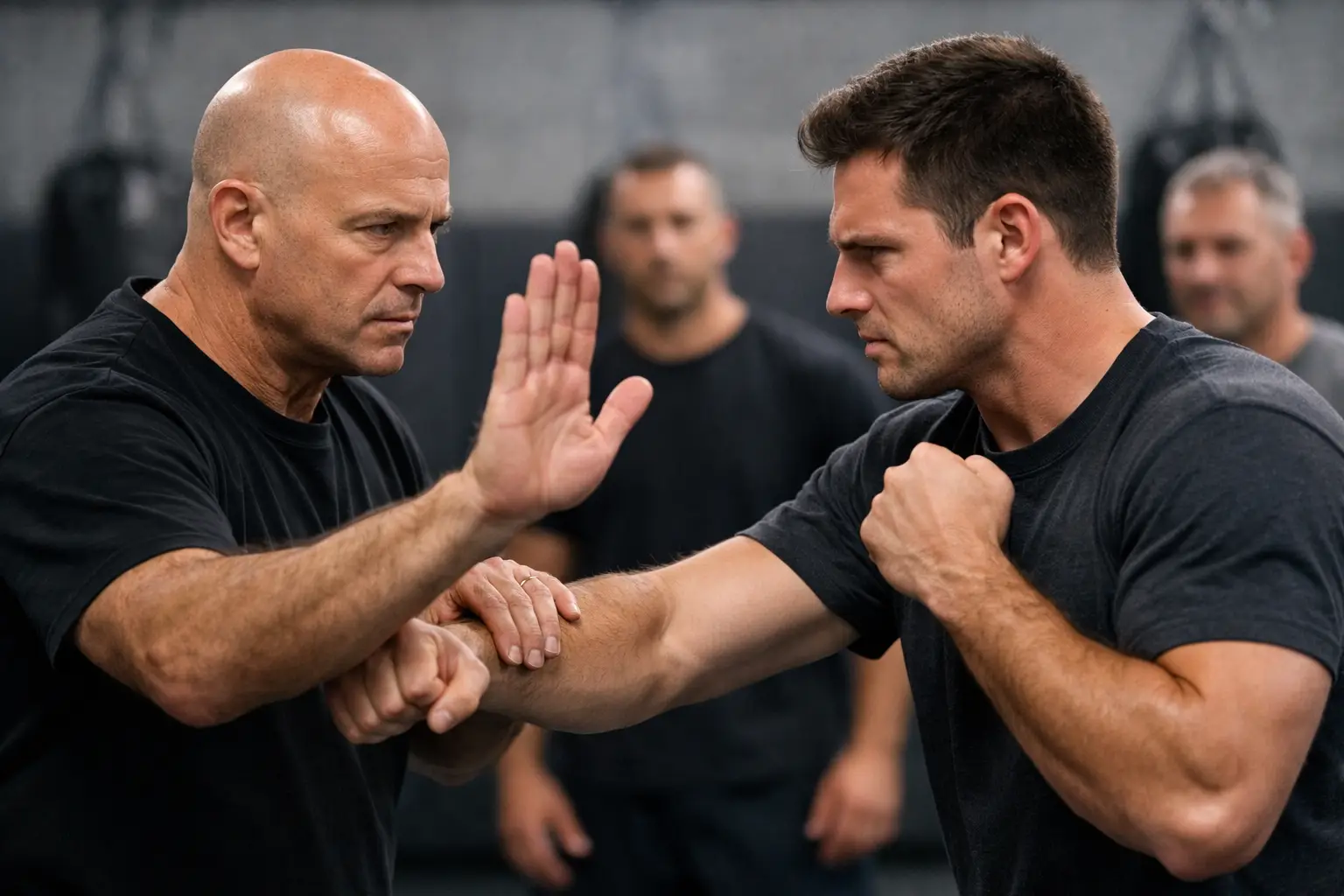
This non-threatening hand position is often called a protective fence. Your palms can face outward as you speak clearly: “Stop.” “Stay back.” “I don’t want any trouble.” It looks natural, but it places your hands where they can protect your head, frame against a push, or intercept an incoming attack. Strong verbal boundaries and smart positioning can end many encounters without a strike being thrown.
Essential Defense Techniques Begin With a Simple Mindset
Under stress, people tend to freeze, flinch, or attempt techniques that are too complicated to remember. Effective training replaces hesitation with a simple decision process: identify the threat, protect vital targets, counter only as needed, and escape.
Your vital targets include the head, throat, groin, and knees. Protecting them does not require a perfect stance. Bring your hands up to guard your head, tuck your chin, bend your knees slightly, and keep your base under you. If you are knocked off balance easily, every other technique becomes harder.
The goal is not to trade punches. The goal is to interrupt the attacker’s ability to continue. In a genuine assault, a fast counter to a vulnerable area may create the seconds you need to break contact and run. The appropriate response depends on the threat, your environment, local law, and whether escape is available. Force must be reasonable and necessary for the danger you face.
This is a critical trade-off in self-defense training. A technique that is highly damaging may be appropriate against an immediate violent assault but completely inappropriate during a verbal argument. Judgment is part of the skill. Train to de-escalate when you can and act decisively when you cannot.
Protect Against Common Attacks
Most people do not need a catalog of hundreds of moves. They need dependable responses to the kinds of attacks that occur at close range: grabs, pushes, chokes, punches, and attempts to force them to the ground.
Escaping a Wrist Grab
A wrist grab can be used to control, pull, intimidate, or prevent you from leaving. Do not try to overpower the attacker by pulling directly against their grip. Instead, identify the weakest point of the hold, usually where the attacker’s thumb meets their fingers.
Turn your wrist toward that opening while stepping back or to the side to create distance. Use your free hand to assist if needed, then immediately move away. If the person continues to close in, use your voice, protective fence, and a decisive counter only if necessary to break the assault and escape.
The detail that matters most is movement. Standing still while trying to peel away a grip leaves you in range for a second grab or strike. Combine the release with footwork from the beginning.
Defending Against a Push or Straight Punch
A push is dangerous because it can send you into a wall, onto concrete, or off balance just before a follow-up attack. Lower your center of gravity by bending your knees and stepping to stabilize rather than locking your legs. Bring your hands up immediately. A shove that seems minor can become a serious assault quickly.
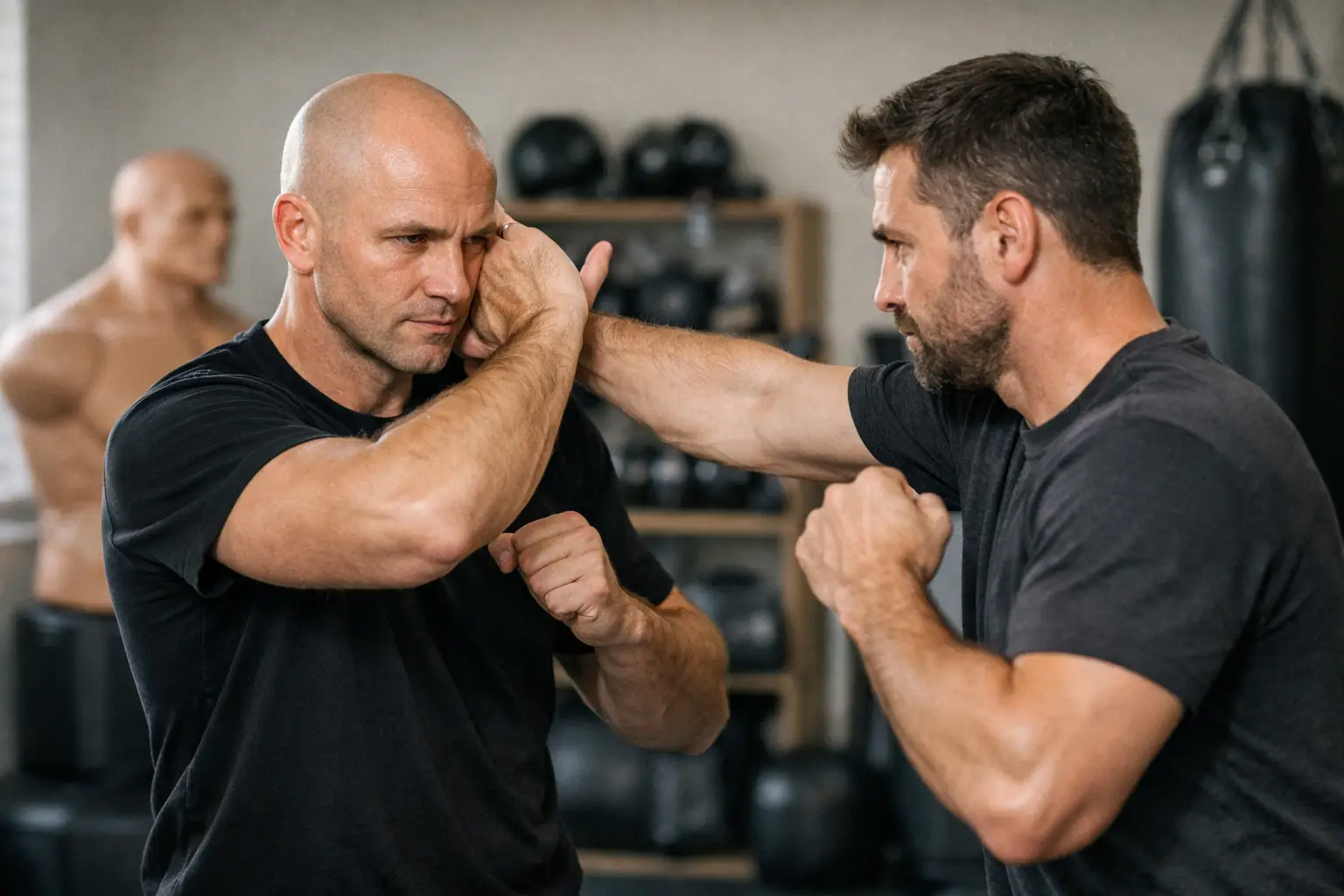
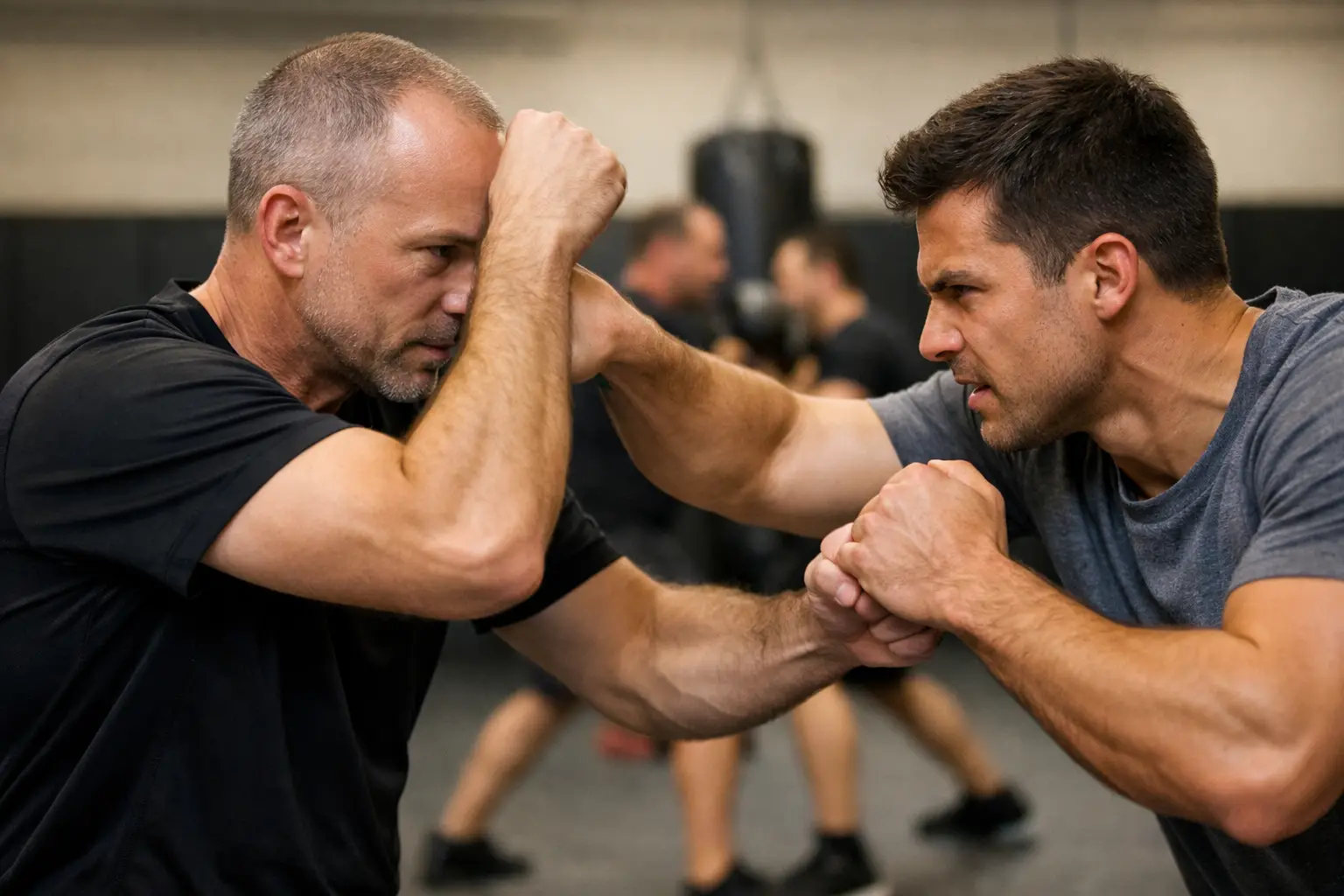
Against a straight punch, avoid reaching wide or trying to catch the fist. Cover your head, keep your elbows close, and move your body off the line of attack. A compact forearm shield can protect your head while positioning you to counter and exit. The tighter and simpler your defense, the more likely it is to work under pressure.
Train both sides. Real attacks are messy, and the direction of the punch may not be the one you expect. Your response should protect you whether the attacker uses the right hand, left hand, or a rapid series of strikes.
Escaping a Front Choke
A choke is an emergency. If someone is restricting your airway or blood flow, you cannot afford to rely on passive resistance. First, protect your ability to breathe by lowering your chin and using your hands and body position to relieve pressure. At the same time, deliver a forceful counter to create a reaction, remove or redirect the hands, and move away.
The sequence must be trained with a qualified instructor because timing, body mechanics, and safety matter. Do not rehearse chokes at full force with an untrained partner. A realistic response is not about performing a polished demonstration. It is about recognizing the urgency, acting explosively, and escaping as soon as contact breaks.
Surviving on the Ground
The ground is not where you want to stay in a self-defense situation. Concrete, multiple attackers, hidden weapons, and limited mobility all make it a dangerous place. If you fall, protect your head, keep your knees between you and the attacker when possible, and use your legs to manage distance.
Learn a technical stand-up: post with one hand behind you while keeping your other hand up to protect your head, bring one foot underneath your body, and rise while maintaining visual contact with the threat. Do not turn your back simply because you are eager to run. Get up under control, create space, then leave.
Train the Skills That Make Techniques Reliable
Watching a video can teach you the shape of a movement. Repetition teaches your body to use it when adrenaline is high. Start slowly and precisely, then add speed, movement, verbal commands, and realistic scenarios as your control improves.
A productive solo session can include shadow movement, protective-fence practice, palm-strike mechanics on an appropriate training pad or bag, footwork drills, and technical stand-ups. If you have a trusted partner, begin with controlled grab releases and light defensive movements. Agree on intensity before each drill, use protective equipment where appropriate, and stop immediately if someone feels pain or discomfort.
Train short sessions consistently. Twenty focused minutes several times a week will build more usable skill than one intense session every few weeks. Keep a progression mindset: first learn the position, then add movement, then add resistance, then practice decisions under pressure.
That structure is especially valuable for people training at home, without a local school, or around an irregular work schedule. A formal belt-based curriculum gives each technique a place, prevents gaps in your training, and makes improvement measurable rather than random.
Build Readiness Beyond the Technique
Physical techniques are only one layer of personal safety. Your phone should be charged when possible. Let someone know where you are when meeting a new person. Park in visible areas. Avoid isolated shortcuts. If you believe you are being followed, do not go home. Move toward a public location and contact emergency services.
For military, law enforcement, private security, and close-protection professionals, the same principles apply but the operational context is different. Policy, legal authority, equipment, team communication, and mission objectives shape the correct response. Professional training should go beyond civilian self-defense drills and include scenario-based decision-making within the rules of the role.
For civilian students, the standard remains clear: avoid danger when possible, act when necessary, and escape when you can. Krav Maga Online provides a structured path for building these skills through progressive instruction, allowing beginners and experienced practitioners to train on a schedule that fits real life.
The next time you practice, do not chase a complicated move. Practice noticing space, setting a verbal boundary, protecting your head, moving your feet, and getting safely back up. Those disciplined basics are what give you options when options matter most.