A missed class should not become a missed year of training. If you have no local school, an unpredictable schedule, or no reliable partner, learning how to start krav maga alone gives you a practical way to build the habits that make self-defense training matter: awareness, movement, balance, speed, discipline, and decisive action.
Training alone has limits, and serious students should respect them. You cannot safely reproduce every grab, choke, weapon threat, or stress response without qualified coaching and eventually a trained partner. But you can build a powerful foundation at home. The goal is not to pretend you are ready for every confrontation after a few workouts. The goal is to establish correct mechanics and a structured progression so that each session moves you closer to real capability.
Start Krav Maga Alone by Building Your Base
The first mistake beginners make is chasing advanced techniques before they can move well. Krav Maga is built for practical self-protection, but practical does not mean careless. A strong stance, controlled footwork, protective hand position, and the ability to generate force under balance are not optional details. They are the platform beneath every strike and defense.
Begin in a neutral fighting stance. Place your feet about shoulder-width apart, with one foot slightly forward. Keep your knees soft, your weight balanced, your chin down, and your hands high enough to protect your head. Your elbows should stay close enough to defend your body without making your posture rigid. If you feel planted, narrow, or off-balance when you step, adjust before you add speed.
Practice moving forward, backward, and laterally without crossing your feet. Your stance should travel with you. For a forward step, move the lead foot first, then bring the rear foot back into position. For a backward step, move the rear foot first. Work slowly in front of a mirror or record a short video on your phone. Seeing your posture is often more valuable than simply feeling it.
Use rounds rather than random repetition. Two minutes of focused movement, followed by one minute of rest, is enough to expose weak balance and poor posture. Complete three to five rounds. At this stage, clean movement is the win. Do not rush to exhaustion.
Learn the Core Strikes Before Complex Defenses
Your early solo training should concentrate on high-percentage tools: palm strikes, straight punches, elbows, knees, front kicks, and low kicks. These are direct, adaptable movements that can be trained on air, a suitable striking pad, or a heavy bag when available.
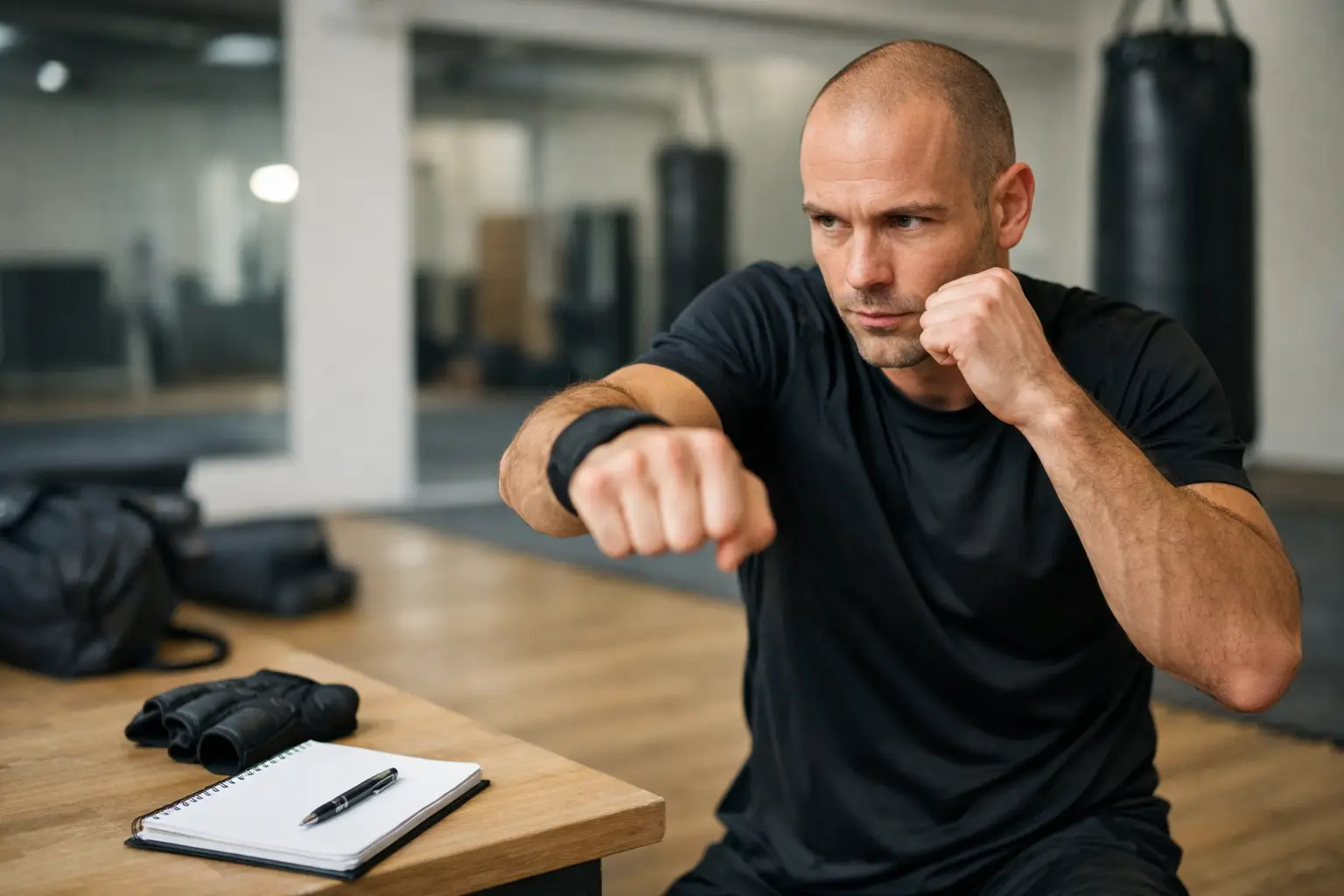
Start with the palm strike and straight punch. Drive from the floor, rotate the hip and shoulder together, keep the opposite hand protecting your face, and return to your guard immediately. Do not let your arm reach so far that your shoulder rises or your balance breaks. Power that leaves you exposed is not useful power.
Elbows and knees deserve equal attention because close-range situations are common in real assaults. For an elbow, turn your body rather than swinging only the arm. For a knee, keep your posture tall, pull the imagined target toward you only if you can maintain balance, and drive the hip forward. Train both sides. A threat will not always appear on your preferred side.
Kicks should remain simple. A front kick can create distance, while a low kick can disrupt mobility. Keep the chamber compact, strike with control, and recover your stance without falling forward. High kicks may look impressive, but they are not the starting point for a beginner training alone. Stability, distance management, and rapid recovery matter more.
Shadowbox with purpose. Instead of throwing hundreds of loose strikes, use combinations connected to movement: step back, palm strike, straight punch, exit at an angle. Or move forward, strike, knee, create distance. Visualize a specific line of attack, then finish every sequence by moving away. Krav Maga is not about staying in a fight to prove a point. It is about creating an opportunity to get safe.
Build Fitness That Supports Self-Defense
You do not need a home gym to start, but you do need physical preparation. Under pressure, technique deteriorates when your legs are weak, your lungs are exhausted, or your core cannot keep you stable. A short conditioning block after technical work will make your solo practice more useful.
Prioritize bodyweight squats, lunges, push-ups, planks, and controlled burpees. Add short intervals of fast footwork, knees, or shadowboxing to develop the ability to move while fatigued. Begin with three training days per week if you are new to exercise. More is not always better. Your joints, tendons, and technique need time to adapt.
A simple session might include 15 minutes of stance and footwork, 20 minutes of strike mechanics and combinations, then 10 to 15 minutes of conditioning. That is enough to create meaningful progress when repeated consistently. If you already have a martial arts or fitness background, increase intensity gradually, not recklessly.
Train Awareness, Not Just Techniques
The most effective self-defense response often starts before physical contact. Solo training gives you an ideal opportunity to build awareness habits that do not depend on a partner. Notice entrances and exits when you enter a building. Keep your phone away when moving through parking areas. Pay attention to distance, unusual behavior, and routes that allow you to leave.
Practice verbal boundaries out loud. A clear command such as “Stay back,” “Stop,” or “I don’t want trouble” can create attention, establish distance, and give you a moment to act. Use a firm voice without unnecessary aggression. The objective is de-escalation whenever possible, not winning an argument.
Mental rehearsal also has value when it stays realistic. Imagine noticing danger, moving toward an exit, using a verbal command, defending only if forced, and leaving immediately. Avoid fantasy scenarios where every threat is defeated with a perfect combination. Reality-based training begins with honest decisions: escape is preferable, and physical force is a last resort when there is no safer option.
How to Start Krav Maga Alone Without Creating Bad Habits
The challenge of solo training is not motivation. It is feedback. Without an instructor or partner, small errors can become automatic. That is why a formal curriculum is more valuable than a collection of social media clips. You need a progression that explains what to train first, why it works, what common errors look like, and when a skill is ready to advance.
Use video recording as a training tool. Film one round from the front and one from the side. Check whether your hands drop after you strike, your feet cross during movement, or your chin lifts when you accelerate. Correct one issue at a time. Trying to repair everything in a single session usually creates confusion.
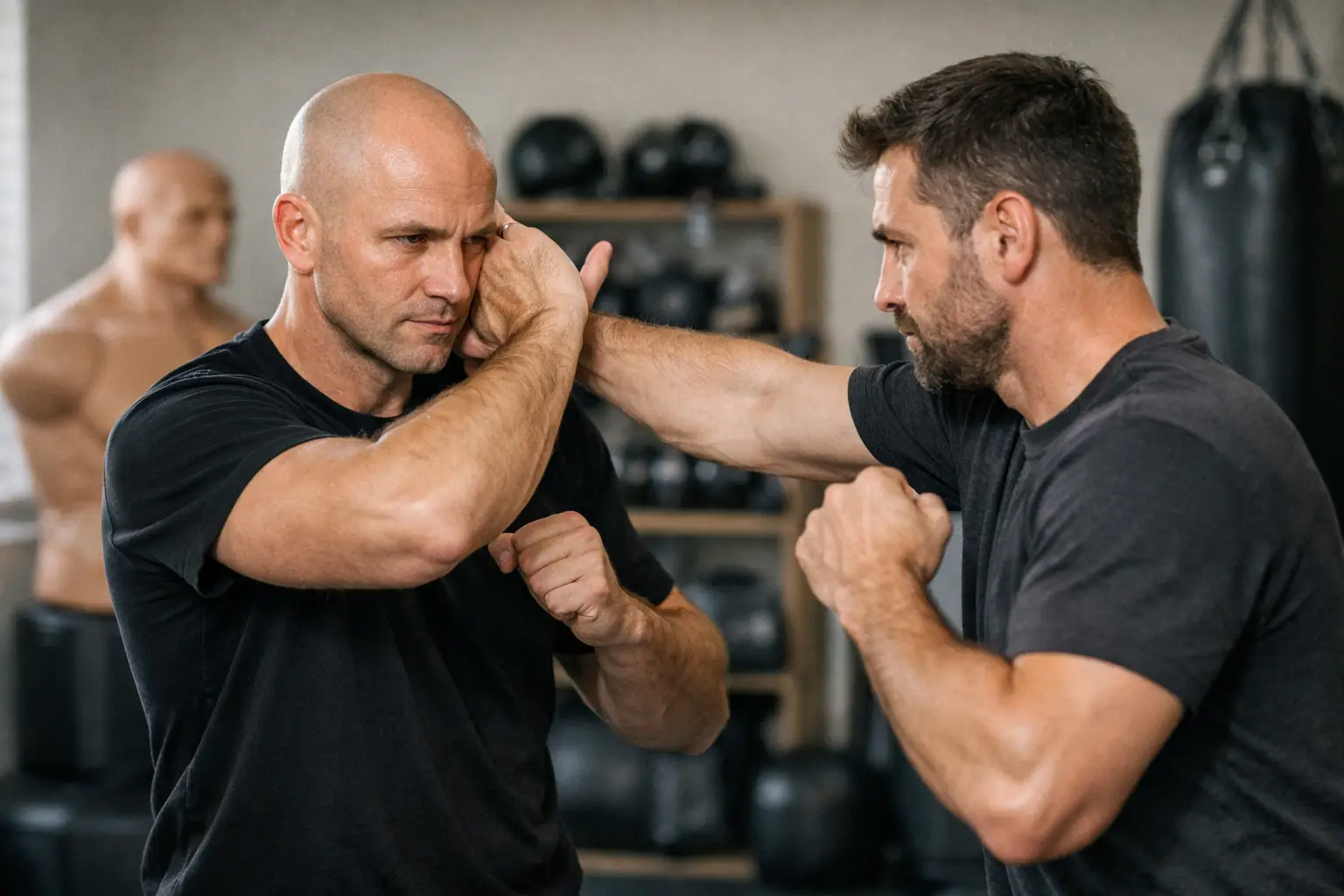
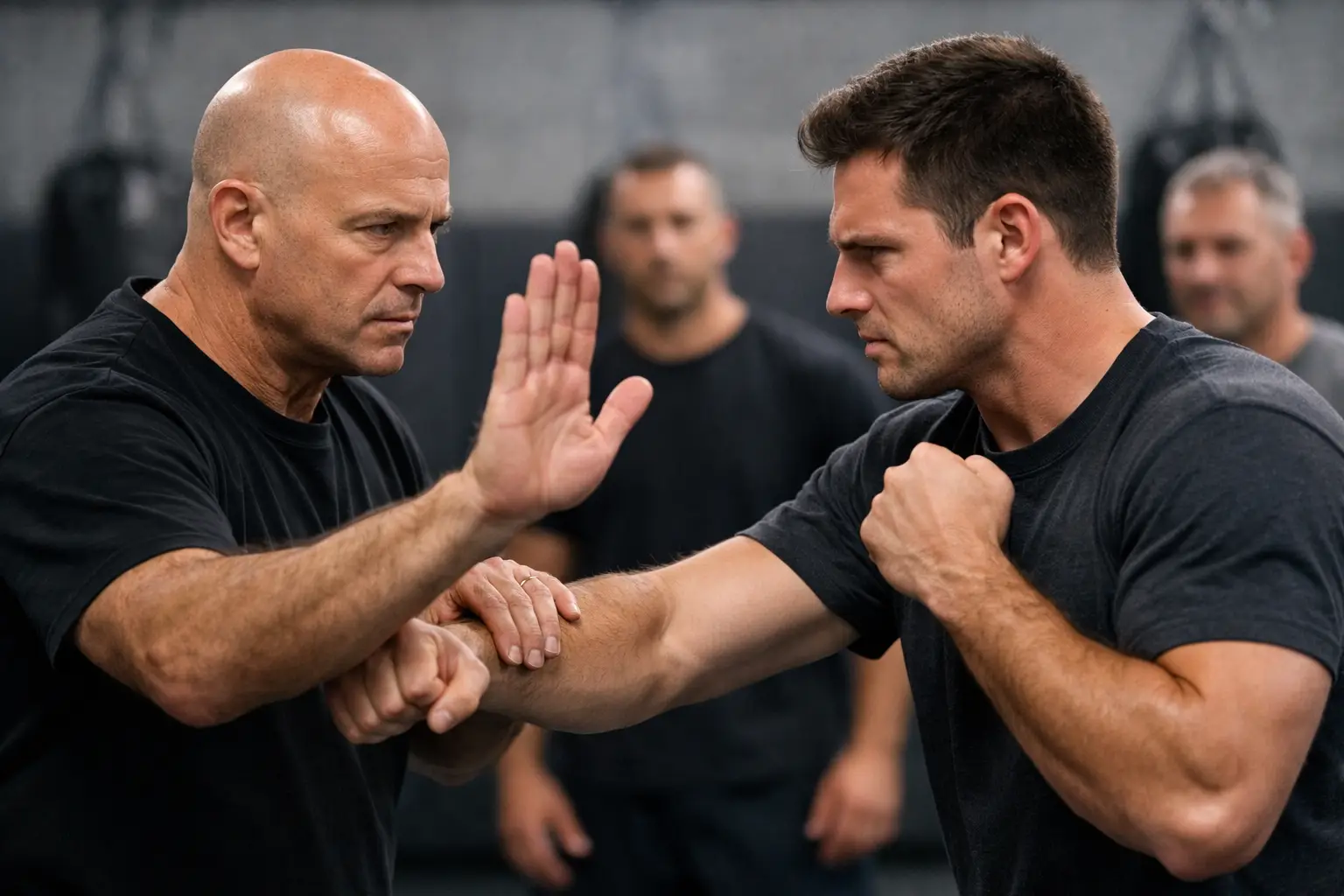
Do not drill dangerous defenses against improvised equipment or untrained people. Neck restraints, weapon defenses, throws, ground-fighting transitions, and high-impact partner drills require careful instruction and controlled practice. The same applies to striking hard surfaces. A wall, a tree, or an unpadded object can injure your hand faster than it improves your technique.
This is where a guided online academy can give independent students a serious advantage. Krav Maga Online provides structured belt-by-belt instruction under Master Alain Cohen, allowing you to train on your schedule while following a clear path rather than guessing what comes next. Treat instruction as coaching, not background entertainment: pause, repeat, compare your mechanics, and earn progression through consistent practice.
Create a Schedule You Can Actually Keep
Consistency beats occasional marathon sessions. Choose three fixed training windows each week, even if each one lasts only 30 to 45 minutes. Write down what you trained, where you struggled, and what you will repeat next time. A training log turns vague effort into measurable progression.
For the first month, focus on stance, footwork, guard recovery, basic strikes, conditioning, and awareness. In the second month, add more structured combinations, defensive movement, and controlled bag work if you have proper equipment. As your foundation improves, seek opportunities for supervised partner training, workshops, or coaching feedback. Solo work can take you far, but pressure testing and safe partner practice reveal what isolation cannot.
Your first goal is not a belt, a highlight reel, or the appearance of toughness. It is the quiet confidence that comes from knowing you can move with balance, protect yourself with purpose, recognize danger earlier, and keep training when life makes a gym schedule impossible.