A parking lot, elevator, workplace hallway, or front door does not give you time to warm up, stretch, or remember a complicated sequence. The best self defense skills adults can build are the ones that help them spot trouble early, create distance fast, protect themselves under pressure, and get home safely.
That standard matters. Self-defense is not about looking impressive or winning a fight. It is about recognizing danger, making decisive choices, and using simple actions that still work when your heart rate rises and fine motor control drops. For adults with busy schedules, the right training must also be structured enough to build real progress without requiring a permanent gym schedule or a training partner every day.
What Makes a Self-Defense Skill Worth Learning?
A useful self-defense skill must be practical before it is technical. It should address situations adults are more likely to face: an unwanted grab, a close-range assault, an attempted choke, a threat in a confined space, or the need to move past someone blocking an exit.
The strongest skills share several qualities. They are simple enough to recall under stress, adaptable to different body types, and built around natural movements such as stepping, turning, covering the head, pushing, striking, and running. They do not depend on an attacker standing still, following rules, or giving you room to perform a perfect technique.
Training also needs progressive resistance. Learning a motion slowly is the starting point, not the finish line. A skill becomes more dependable when you can perform it while moving, after physical exertion, from an awkward position, and with a clear decision to escape immediately afterward.
Best Self Defense Skills Adults Need First
Situational awareness and early decision-making
Awareness is not paranoia. It is the disciplined habit of noticing your environment before you are forced to react. Adults should learn to identify exits, keep appropriate distance from strangers who create concern, avoid becoming absorbed in a phone while walking, and trust behavioral warning signs.
The goal is to act before a situation turns physical. Cross the street. Leave the room. Change your route. Ask for help. These are not timid choices. They are intelligent risk-management decisions that deny an aggressor the opportunity to control distance and timing.
Good awareness also includes verbal boundaries. A clear, firm command such as “Back up” or “Stay away from me” can draw attention, establish your intent, and create a moment to move toward safety. Practice speaking loudly and directly. Under pressure, many people become quiet or apologize when they should be creating space.
Movement, distance, and positioning
Distance is one of your greatest assets. If you are out of reach, you have more time to see, decide, and leave. If you are trapped at close range, your options narrow quickly.
Adults should practice a stable but mobile stance: feet under the body, knees soft, hands positioned naturally between themselves and a potential threat. This stance should not look theatrical. It should let you move backward, angle away, protect your head, and respond if someone suddenly closes distance.
Stepping off the direct line of attack is often more useful than retreating straight back. An angle can place you beside an attacker rather than directly in front of them, opening a path to an exit. This is especially valuable in hallways, parking areas, and other places where space is limited.
Breakfalls and getting up safely
Falling is a real part of self-defense, whether someone pushes you, you trip while moving away, or a struggle takes you to the ground. Learning how to reduce the impact of a fall and get up without exposing yourself is a serious adult skill.
The priority is protecting the head, managing the landing, creating space with your legs when necessary, and standing without turning your back on the threat. Ground survival is not the same as choosing to wrestle. For most civilians, the mission is to prevent being pinned, recover their feet, and escape.
This is an area where controlled instruction matters. Repetition develops safer habits, but training should account for age, mobility, past injuries, and fitness level. A 25-year-old athlete and a 60-year-old beginner may use the same principles with different intensity and range of motion.
Escaping common holds and chokes
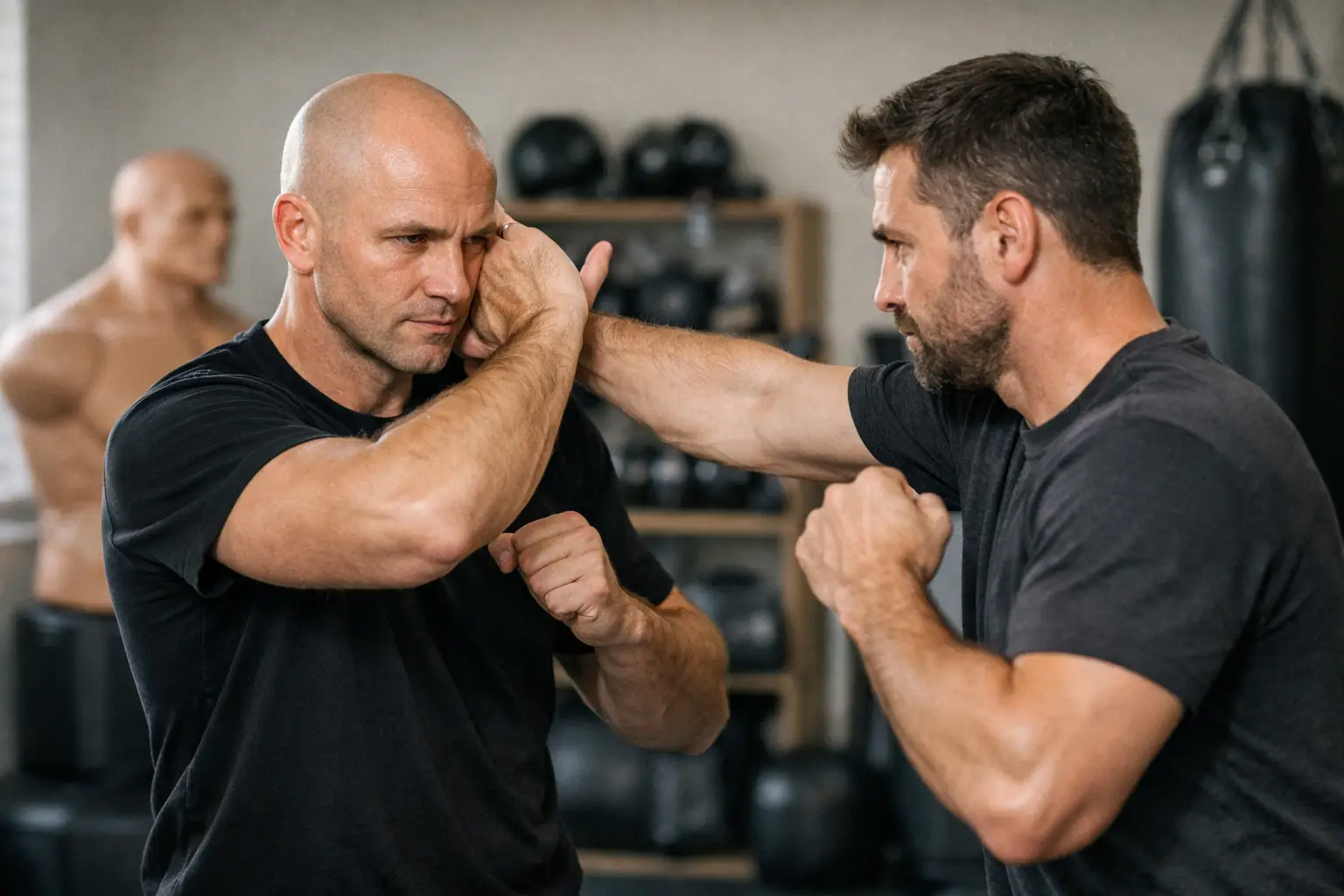
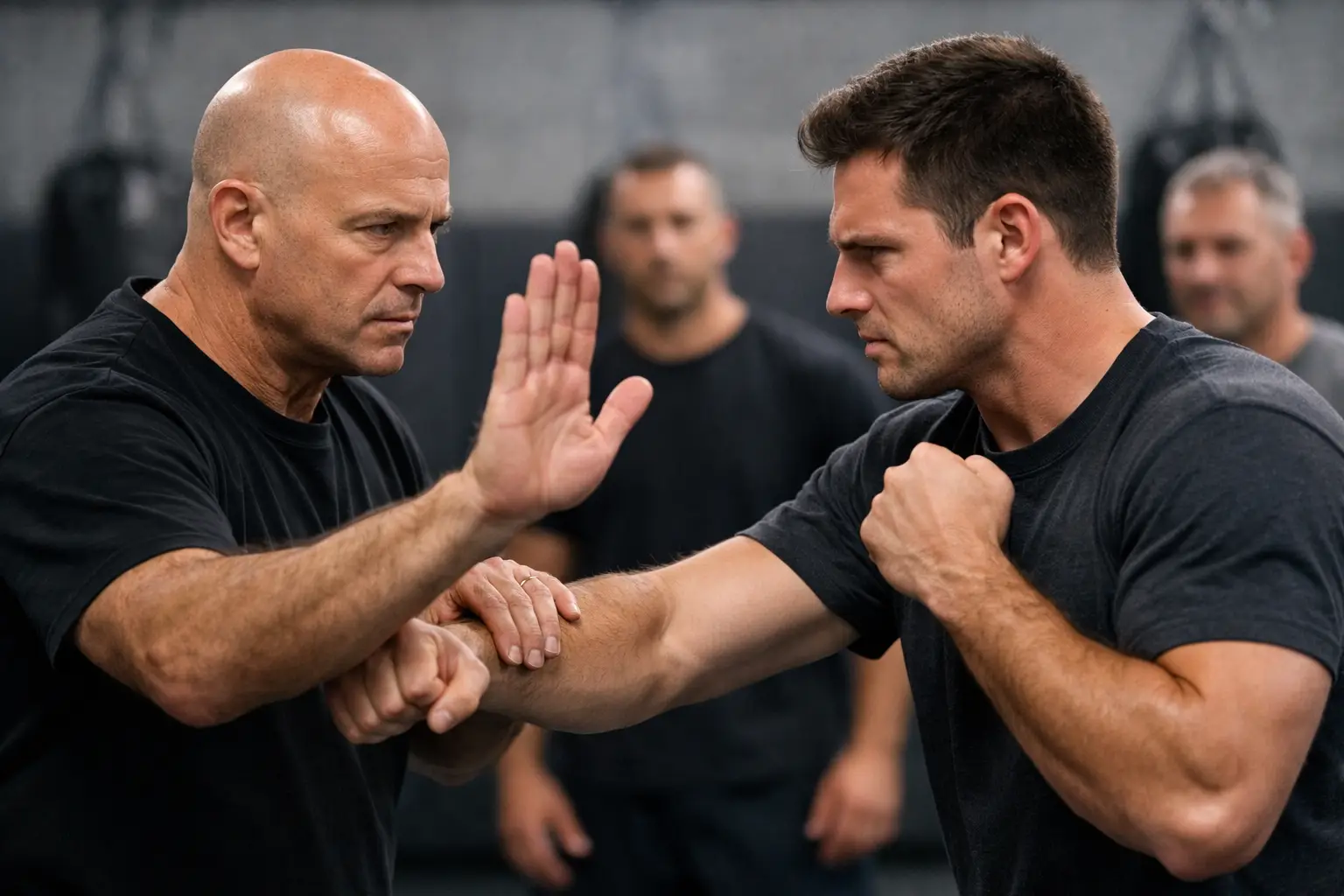
Many real assaults begin with contact: a wrist grab, clothing grab, bear hug, headlock, or choke. The answer is not to memorize dozens of elaborate counters. It is to understand the core priorities: protect the airway, maintain balance, disrupt the attacker’s control, and move toward an exit.
Krav Maga emphasizes direct responses because delay is dangerous at close range. Escapes should combine defensive body positioning with immediate counteraction when required to create an opening. Once the hold is broken, distance is the objective. Remaining close to prove a point creates unnecessary risk.
Choke defenses deserve particular attention because they can become life-threatening quickly. Training must teach recognition, body positioning, decisive action, and follow-through. It should also emphasize that a defense has to be delivered with urgency, not hesitation.
Simple, high-percentage striking
Striking is not the first answer to every confrontation, but it may be necessary when escape is blocked or an assault is already underway. Adults benefit most from gross-motor strikes that can be delivered from natural positions at close range: palm strikes, elbows, knees, and low-line kicks.
The purpose is not to exchange combinations like a sport fighter. It is to interrupt the attack, damage the aggressor’s ability to continue, and create enough time and space to leave. Targets, timing, balance, and aggression all matter. So does knowing when not to strike, particularly if verbal disengagement and safe exit remain available.
Training on pads can develop mechanics and confidence. Training through realistic scenarios teaches a different lesson: how to strike while startled, crowded, off-balance, or verbally pressured. Both have value, but scenario context is what connects technique to self-defense.
Defending the head and recovering under pressure
An adult does not need to become a professional fighter to learn how to cover the head, manage a flurry of strikes, and move toward safety. A functional defense starts with a protective frame, chin position, forward awareness, and active footwork.
The common mistake is freezing after the first surprise attack. Effective training conditions a recovery response: cover, move, counter if necessary, and escape. This sequence is more valuable than assuming every threat begins with a clean, predictable punch.
Why Structured Krav Maga Training Fits Adult Learners
Krav Maga was built around practical defensive principles rather than competition rules. It addresses the realities that concern many adults: sudden violence, close-range contact, multiple possible threats, environmental obstacles, and the urgency of getting to safety.
The method works best when it is taught in a logical progression. Beginners need foundations in stance, movement, awareness, basic strikes, and core releases before moving into more complex defenses. Each layer should reinforce the one before it, so techniques become available under stress rather than remaining isolated video demonstrations.
For people without consistent access to a local school, online training can provide that structure when the curriculum is clear and instruction is precise. Krav Maga Online offers a belt-by-belt pathway led by Master Alain Cohen, allowing students to develop fundamentals, revisit lessons, and progress around work, travel, and family commitments. Online study does not remove the value of partner practice, pad work, or qualified in-person feedback when available. It does make disciplined, repeatable instruction accessible when a traditional class schedule is not.
Train for Reality, Not for Certainty
No self-defense system can promise a guaranteed outcome. Size, surprise, weapons, multiple attackers, environment, and legal considerations all change the situation. The purpose of training is not certainty. It is better preparation, faster recognition, stronger decision-making, and more capable action when options are limited.
Build your training around consistency. Practice movement and protective positions until they feel natural. Rehearse verbal boundaries. Learn escapes in stages. Add controlled intensity over time. If you can train with a trusted partner or qualified instructor, use that opportunity to test distance, timing, and resistance safely.
The best skill is often the one that prevents the physical encounter. But when prevention fails, a trained adult has more than hope. They have a plan: protect, respond, move, and get to safety.